Plaintiffs’ lawyer in the Monafeghin case: The Monafeghin collaborated openly with the Zionist regime during the 12-day war
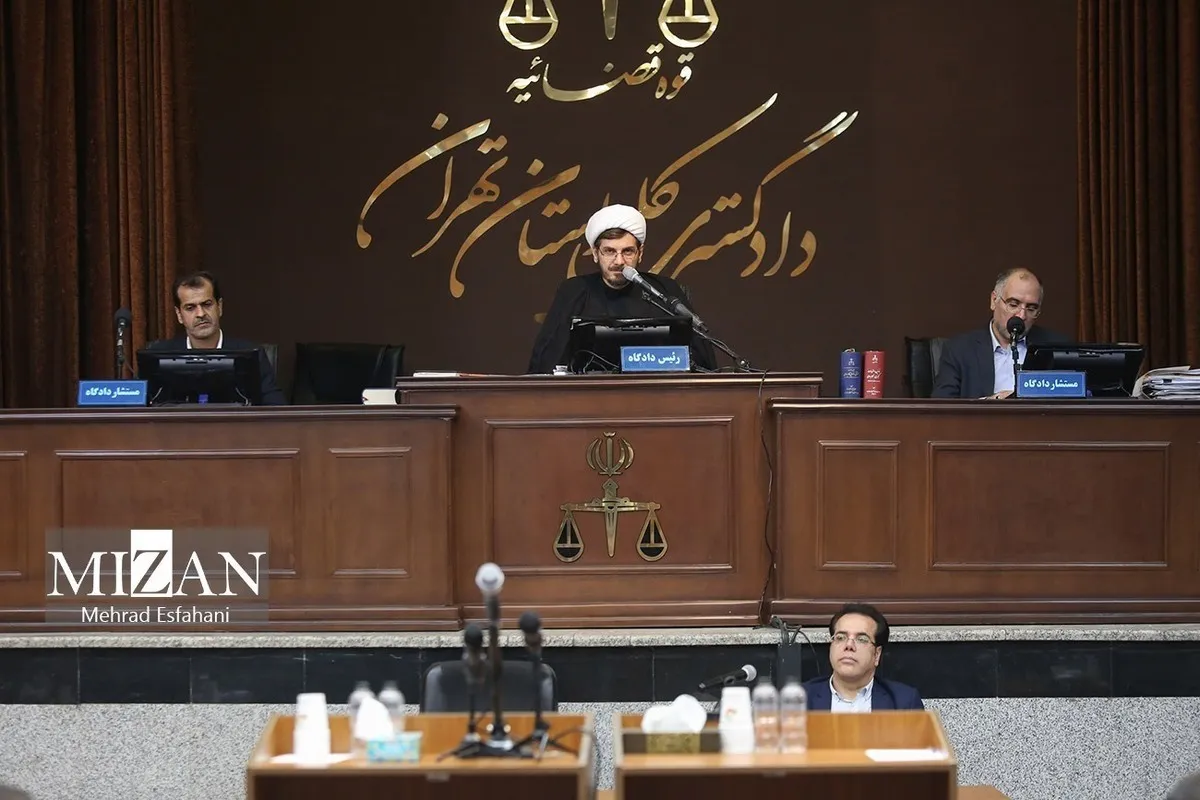
At the start of the session, the judge invited the plaintiffs’ lawyer to the stand to present his statements.
Masoud Maddah, the plaintiffs’ lawyer, appeared before the court and said: “There is no doubt about the Monafeghin’s awareness of the hostility of Iran’s enemies—including the Baathist regime, the United States, and the Zionist regime. Several examples mentioned in the indictment highlight this. During the time when Iraq was at war with Iran—which was the clearest example of hostility—Masoud Rajavi collaborated with Saddam’s Baathist regime. This cooperation went beyond espionage, intelligence sales, and phone surveillance; it extended to killing, looting, and directly participating in the massacre of the Iranian people.”
Masoud Maddah added: “The same rhetoric that the Monafeghin used against the Iranian people in the 1980s was echoed by Maryam Rajavi during the recent 12-day war with the Zionist regime. Speaking at the European Parliament, she described it as ‘the beginning of a new chapter, our real war that has been ongoing for 44 years.’ This leaves no doubt that their aim has always been against the Islamic Republic and the Iranian people.”
He continued: “In Mojahed magazine, issue 348, the Monafeghin claimed that ‘the overthrow of the regime by the Liberation Army with the help of the heroic people of Iran has gained momentum.’ They imagined that if they attacked, the Iranian people would join them, allowing them to conquer the country in three days. Again, in issue 499, the so-called National Council of Resistance explicitly emphasized overthrowing the Islamic Republic by the Liberation Army. Their activities were openly against the sacred Islamic system and the Iranian people, and they have continued such actions to this day.”
Maddah further stated: “During the 12-day war with the usurping Zionist regime, they explicitly engaged in espionage, selling information, phone surveillance, and providing assistance to the Zionist intelligence services. Rajavi once collaborated with SAVAK, then with Saddam, and now, during the 12-day war, with the Zionist regime. They issued statements against Iran’s nuclear power and scientists, clearly aligning themselves with the Zionists. This proves the criminal intent of the Monafeghin, and it is important to note that such collaboration was not limited to the leaders. It was an organized effort involving an internal bureau, with one section dedicated solely to wiretapping and espionage, and another tasked with financing.”
The lawyer emphasized that the Monafeghin’s collaboration with hostile states over the past four decades has been systematic: “This is not limited to intelligence-sharing; it involves direct participation. As the widow of martyr Ali-Mohammadi testified in this very courtroom, the Monafeghin spied on and threatened our nuclear scientists. At critical moments, they directly partnered with the enemy.”
Maddah pointed out that the indictment (page 311) mentions the Monafeghin’s cooperation with U.S., Zionist, and Saudi intelligence services in order to carry out terrorist activities and sell classified Iranian information. “What we presented in court, with witnesses, confirms this beyond any doubt,” he said.
He noted that page 312 of the indictment includes confessions by former members of the Monafeghin acknowledging the group’s inhumane terrorist operations. Page 441 also refers to numerous signs of the organization’s dependency on the U.S., Israel, and Saudi Arabia, even though before the U.S. invasion of Iraq, Saddam Hussein was the group’s main sponsor. “This confirms what the experts previously testified in court,” he added.
Maddah stressed: “American support for the group’s crimes—like that of France—was not limited to one period. The documents clearly show that the U.S. was aware of the Monafeghin’s atrocities in the 1980s yet still maintained ties with the terrorist organization. Their collaboration with Israel and the U.S. dates back to the beginning. Today, in Albania, the Monafeghin continues under American and European protection, rebranded as a so-called democratic movement and political alternative, while plotting and directing terrorist activities against the Islamic Republic at all levels.”
At this point, Morteza Simiyari, an expert on West Asia, addressed the court under Article 614 of the Criminal Procedure Code. He said: “As a security expert, I was tasked with analyzing whether intelligence cooperation between the Monafeghin and Mossad has taken place; whether the Monafeghin’s actions constitute the crime of collecting and transmitting classified information to a hostile foreign service; and whether existing evidence proves their role in facilitating terrorist activities.”
Simiyari explained that when the Monafeghin was relocated to Albania between 2013 and 2016, the Albanian government initially opposed hosting them, fearing security risks. However, the U.S. forced Albania to choose between processing Western nuclear waste or hosting the Monafeghin — “social waste,” as he described. Albania reluctantly accepted the latter. From the beginning, the U.S. insisted Albania would only serve as host, while France managed the Monafeghin’s main operations.
After 2016, Mossad intensified efforts to connect with the Monafeghin. He revealed that Mossad established the “Fara” office for the Monafeghin and tasked an operative named Omid Khadir with delivering suitcases of cash from Mossad to the group and facilitating meetings. In 2016, an attempt to smuggle $1 million in cash to Camp Ashraf 3 was intercepted, leading to new methods. In 2018, Albania’s defense minister was invited to Tel Aviv to meet then-defense minister Lieberman and discuss opening a Mossad office in Tirana. This provided Mossad with a diplomatic cover to directly liaise with the Monafeghin.
For the first time, Monafeghin members were taken to Tel Aviv for cyberwarfare training aimed at hostile operations against Iran. Mossad organized cyber units for the Monafeghin to carry out these activities. By late 2018, even Mossad’s Iran desk chief met directly with Monafeghin members—something previously done only through intermediaries.
In one meeting, Mossad demanded three things: activate the cyber units trained by Israel, identify individuals online to connect directly with Israel’s Unit 8200, and encourage others online to engage in terrorist activities. Following this, Soosan Jafarzadeh—sister of notorious terrorist Alireza Jafarzadeh—posed as a monarchist online and entrapped an Iranian citizen in Mashhad through immoral relations, later coercing him into terrorist activity by threatening to expose private material.
Simiyari emphasized the Monafeghin’s deep corruption: “They exploit any means to achieve their goals. In another 2019 meeting at Tirana’s counterterrorism office, Mossad told the Monafeghin that phone surveillance was useless and demanded concrete terrorist operations that would yield visible results.”
He continued: “They were told to create insecurity inside Iran and spread fear in the streets. From 2019 until today, Monafeghin -Mossad relations have been fully structured and comprehensive.”
Simiyari revealed that on June 12, just hours after Israel’s attacks on Iran, an online meeting took place between Monafeghin members in Paris and Mossad. The Monafeghin advised that assassinations and building strikes were not enough for regime change, recommending bombings in public spaces. On June 14, a bomb planted by Israeli operatives exploded in Tajrish, Tehran, killing several civilians including 70-year-old taxi driver Houshang Naserpour, leaving behind two young children. “This attack was carried out based on Monafeghin’s advice to Mossad,” he stated.
After the 12-day war, the Monafeghin, led by Mehdi Abrishamchi, held a meeting at Ashraf 3 in Albania. In reviewing the events, one participant admitted: “We must acknowledge that the Islamic Republic and its intelligence services are so powerful that we are locked down here in Albania, unable to act. All our plans have gone up in smoke.”
Simiyari concluded: “A Mossad officer even told them bluntly: ‘You don’t even have the guts to set off a firecracker! You promised us a thousand victories in Iran, yet you achieved nothing and caused Israel’s