Diplomatic setback for Israel as UN backs UNRWA and ICJ ruling
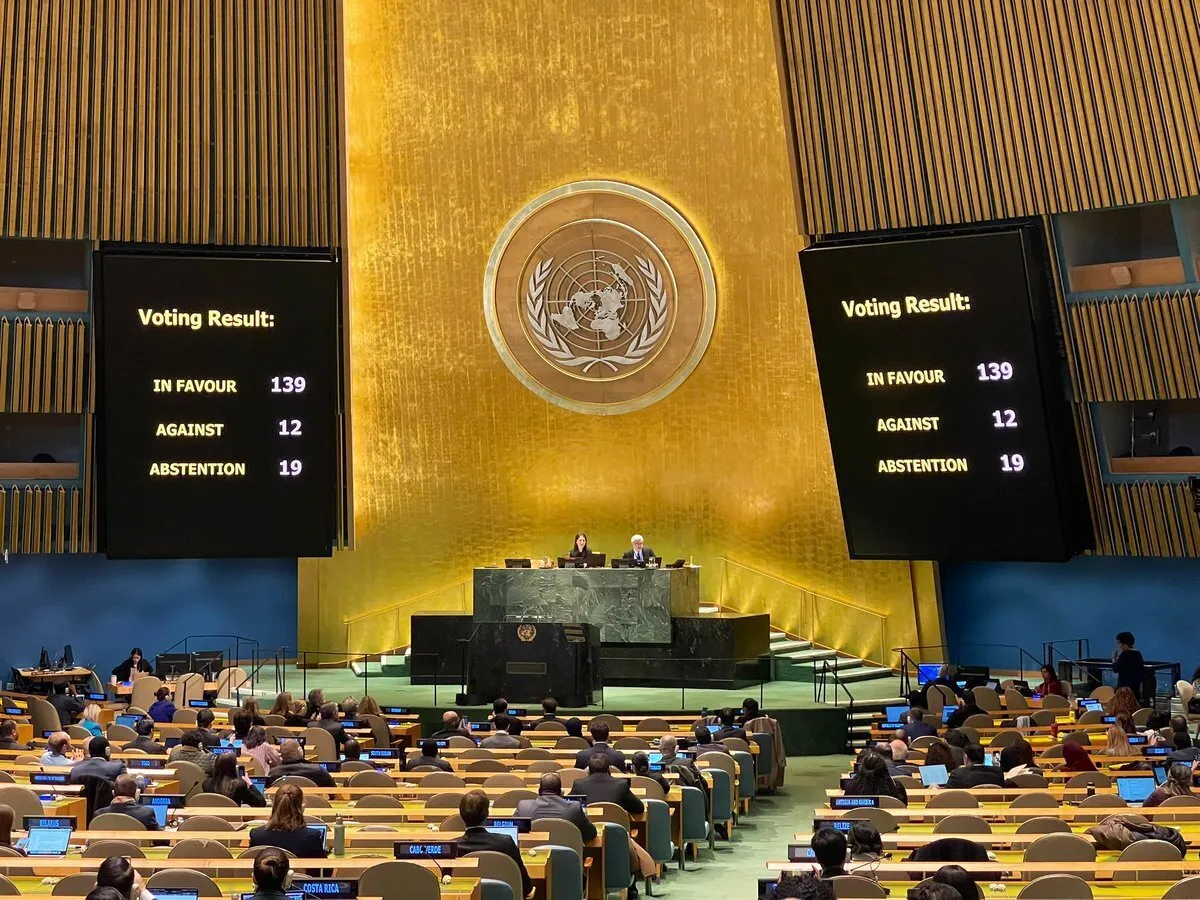
On Friday, December 12, 2025, the UN General Assembly overwhelmingly adopted a resolution endorsing the advisory opinion of the International Court of Justice (ICJ), affirming that the Israeli regime must allow aid to enter Gaza through UN agencies, including UNRWA—the agency specifically established for Palestinian refugees.
UNRWA was founded in 1949 to meet the needs of some 750,000 Palestinians who were expelled from their land during the Nakba, concurrent with the establishment of the Israeli regime. The agency provides healthcare, education, and food assistance.
The UN resolution, introduced by Norway along with more than 12 other countries, received the support of 139 states. Nineteen countries abstained, while 12—including the Israeli regime, the United States, Hungary, and Argentina—voted against it.
In October, the ICJ ruled that the Israeli regime’s ban on the UN’s primary humanitarian aid provider for Palestinians, as well as its restrictions on aid to Gaza and the occupied West Bank, violate international law.
The advisory opinion was issued six months after ICJ hearings in which more than 40 countries and international organizations presented evidence, largely arguing that the Israeli regime has breached its international legal obligations to facilitate aid to the Palestinian population under its occupation.
Only the Israeli regime, the United States, and Hungary rejected the majority opinion in The Hague, calling for an interpretation of international humanitarian law that would limit such obligations based on what they described as Israel’s military and security necessities. The Court rejected these arguments.
Reactions to the adoption of the UNRWA resolution
Rohhi Fattouh, Speaker of the Palestinian National Council, welcomed the resolution, saying the wide margin reflected a firm international position in support of UNRWA and a renewed recognition of its legal mandate and its vital role in assisting Palestinian refugees.
He also warned of a dangerous escalation in occupation-related crimes, ethnic cleansing, and the worsening humanitarian situation in the occupied Palestinian territories.
The Palestinian Ministry of Foreign Affairs said in a statement that the resolution underscores the primacy of international law and the multilateral system in confronting policies that violate the fundamental rights of the Palestinian people.
The statement added that the resolution constitutes “the correct international response” to the Israeli regime’s actions against the UN agency for Palestinian refugees and other UN bodies operating in the occupied Palestinian territories.
Meanwhile, the U.S. State Department claimed that the UN General Assembly had adopted yet another “unserious” resolution, alleging that it reflected bias against the Israeli regime.
The department further asserted that the resolution came at the expense of real diplomacy within the UN, accusing the General Assembly of choosing to advance a divisive and politicized resolution based on false claims. According to Washington, the resolution endorses Israel’s obligation to implement what it called the ICJ’s incorrect and misleading advisory conclusions.
As part of what critics describe as Washington’s broader campaign against international institutions—particularly the United Nations—the U.S. State Department argued that advisory opinions are not a basis for lawmaking and that reliance on them amounts to a mockery of international law.
At the same time, the deputy spokesperson of the U.S. State Department reiterated opposition to any effort to strengthen UNRWA’s role, claiming: “We stand with Israel in rejecting biased and false claims at the United Nations.”
In response to the General Assembly vote, UNRWA Commissioner-General Philippe Lazzarini wrote on X that the vote represented strong support for the ICJ’s ruling in the face of baseless allegations leveled against UNRWA.
He added that the vote was an important signal of the overwhelming support of the international community for UNRWA, stressing that the agency is a key humanitarian actor in the occupied Palestinian territories and that everything should be done to facilitate its work—not obstruct or prevent it.
The Israeli regime’s ambassador to the United Nations also reacted to the vote, claiming that for the sake of world peace, UNRWA must be dismantled.
Potential U.S. sanctions against UNRWA
In January 2024, at the height of what experts have described as the Israeli regime’s genocide in Gaza, Israel leveled baseless and unsubstantiated accusations against UNRWA.
Continuing its support for Israel’s actions in Gaza, the United States—despite having been UNRWA’s largest donor since the agency’s establishment—halted funding during the administration of President Joe Biden.
The Donald Trump administration has taken an even tougher stance. Earlier this year, Secretary of State Marco Rubio said UNRWA could have no future role in governing Gaza.
In October, speaking from the headquarters of the U.S. civil-military coordination center in the occupied territories, which oversees the Gaza ceasefire, Rubio claimed that UNRWA would play no role in delivering aid.
According to Reuters, the United States is considering sanctions against UNRWA that would effectively cut off its ability to conduct U.S. dollar transactions and access banking systems.
UNRWA provides assistance not only in Gaza, but also in the occupied West Bank, Jordan, Lebanon, and Syria, where tens of thousands of Palestinian refugees live in camps.
William Deere, director of UNRWA’s representative office in Washington, D.C., said U.S. sanctions would be unprecedented and would violate multiple obligations of a UN member state under the UN Charter.
He emphasized that several independent bodies have assessed UNRWA and found it to be a neutral and indispensable humanitarian actor.
The executive director of UNRWA-USA—a separate legal entity registered as a nonprofit organization in the United States—also said that sanctions would mean it could no longer transfer U.S. taxpayer-funded donations to their intended destination: UNRWA’s operational centers in Gaza.