Eslami: Cooperation with the IAEA will be based on the new Parliamentary law
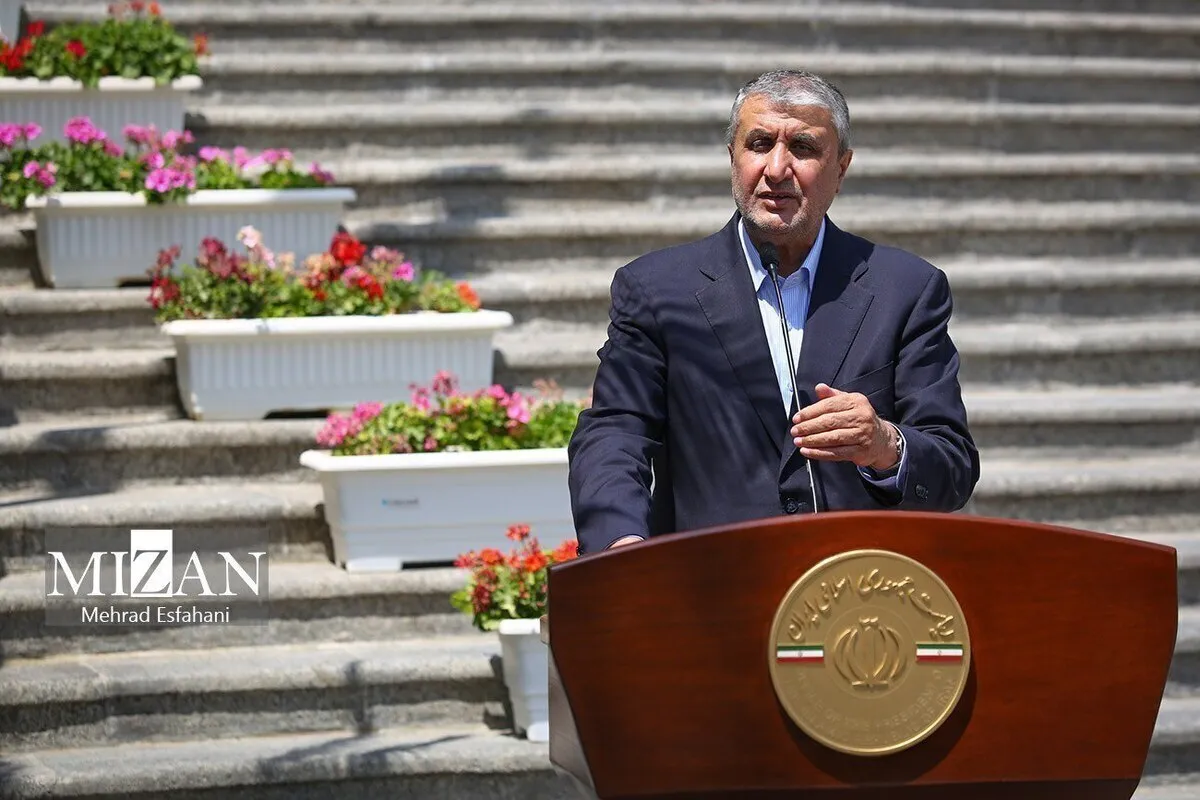
Mohammad Eslami, Vice President and head of the AEOI, spoke to reporters on Wednesday, October 15, 2025, on the sidelines of a Cabinet meeting, responding to questions about the new Iran-Russia power plant contract.
Regarding the contract for building large-scale power plants, Eslami stated:
“Since the 2000s, the contract between Iran and Russia has included the construction of eight large-scale power plants; four of these units, with a combined capacity of 5,000 MW, are planned for Bushehr, and the locations of the other four units were to be announced later by Iran. We have now planned these four additional units in eastern Hormozgan province. This memorandum of understanding essentially serves as a strong confirmation from both sides to expedite the project. It was signed as a kind of pre-contract and will be followed up.”
He added that the second part of the contract concerns small modular reactors (SMRs), which were not included in the original agreement between the two governments. Negotiations have been conducted to add this section as a supplement to the main contract. An initial memorandum was signed in Russia, and in the coming days, the main contract between Iran and Russia will be signed. The operational project has also been negotiated with the relevant company, and the contract is on the verge of being finalized, with the project location already determined.
Eslami expressed hope that after the first pilot in northern Iran, these SMRs would be expanded across the country to meet the needs of large industrial and mining units.
Regarding cooperation with the International Atomic Energy Agency (IAEA), he stated:
“Our benchmark for working with the IAEA is the new law passed by Parliament. This law sets two conditions, and the authority for verification is the AEOI report and the approval of the Supreme National Security Council.”
He also noted that the IAEA has so far failed to fulfill its legal duties: “We have asked the agency to perform its legal obligations. It should have condemned attacks on Iran’s nuclear sites, which it has not, and it has issued no declaration to guarantee the protection of sensitive nuclear information, committing to safeguard Iran’s nuclear industry data.”
Eslami emphasized that until these actions are taken, the parliamentary law cannot be implemented. Consequently, inspections will not follow the IAEA’s own schedule. Only two inspections, coordinated by the Ministry of Foreign Affairs and approved by the Supreme National Security Council, took place — at the Bushehr facilities and the Tehran reactor — after which inspectors left the country.
Finally, he announced the opening of a new irradiation center in Ardabil: “As part of our irradiation development program, a new center will soon be inaugurated in Ardabil. This system will address one of the country’s key challenges in preserving agricultural products. This is a step forward in expanding the previously promised twelve irradiation zones, which will soon be operational.”