Baghaei: Iran is prepared for any eventuality
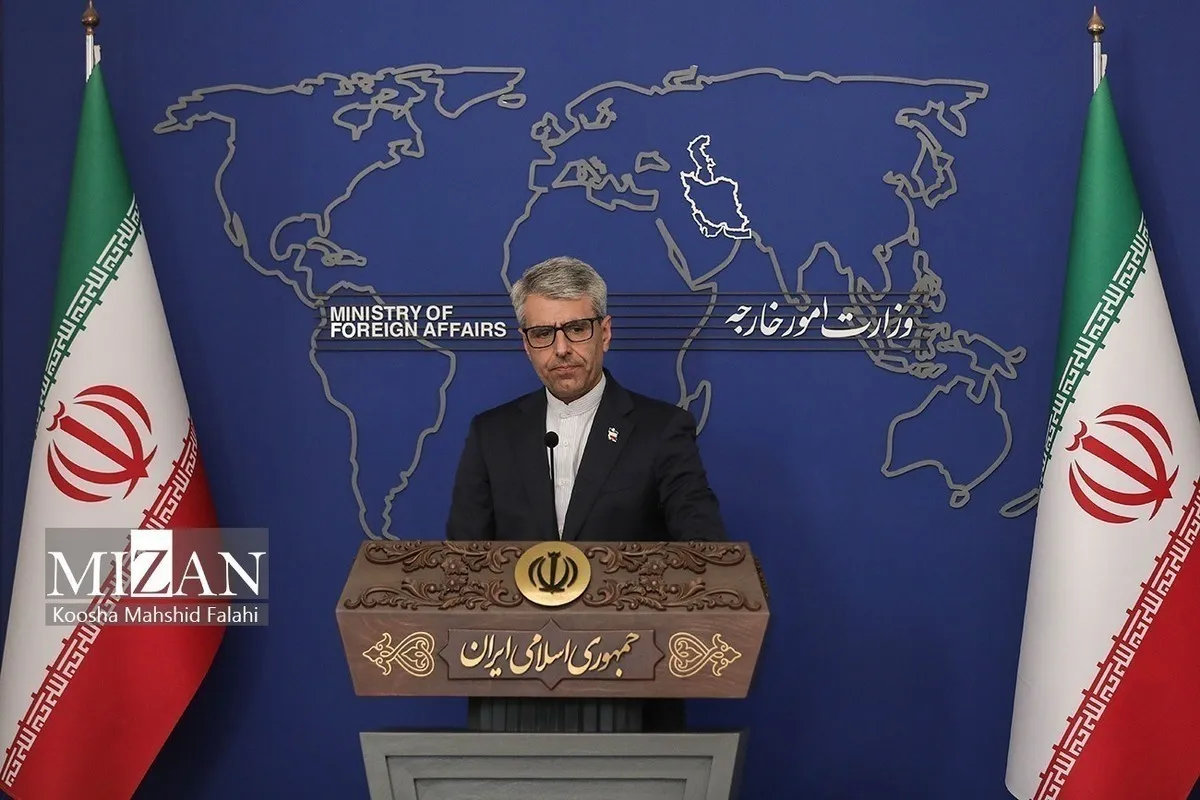
At the beginning of the briefing, Baghaei provided an overview of the key foreign policy events of recent days, stating: “Regional and international developments are rapidly unfolding. The most important issue in the region is the continued acts of aggression by the Zionist regime against neighboring states and its violation of the ceasefire in Gaza. The ceasefire in Lebanon has been violated hundreds of times, resulting in assassinations of Lebanese civilians. In Gaza, the ceasefire violations have now reached 600 cases, each of which leads to the killing of innocent people.”
Regarding the continuation of U.S. unilateralism, the spokesperson said: “The reality is that through its recent behavior, the United States has turned into the greatest threat to international peace and security. We are witnessing America’s blatant coercion and threats across various parts of the world.”
Referring to recent U.S. actions in the Caribbean and toward Venezuela, he added: “Declaring the closure of a country’s airspace is unprecedented and contrary to international law, including aviation safety regulations. U.S. unilateral actions—from the Caribbean Sea to Africa and West Asia—continue. The UN Security Council must declare these actions a gross violation of international peace and security. Such U.S. measures are becoming a model for other actors, effectively normalizing criminal behavior at the international level.”
Addressing the visit of Saudi Arabia’s Deputy Foreign Minister to Iran, Baghaei said: “This visit is part of a process that began two years ago.”
He noted that relations between Iran and Saudi Arabia have improved during the past two years: “The Saudi official’s visit focused on issues of mutual concern, including developments in Lebanon, Syria, and occupied Palestine. Both countries are determined to continue building confidence and strengthening stability in West Asia.”
He emphasized that the visit was technically in response to a trip made by Iran’s representative for Syrian affairs several months ago: “All regional developments matter to us. This visit mainly focused on the situation in Syria, and the Saudi official mostly met with Iranian officials working on Syrian affairs. We hold consultations with all regional countries regarding Syria.”
He added: “Syria’s security is a shared concern among regional states. Ongoing Israeli aggression against Syria is a critical issue. Saudi Arabia is not acting as an intermediary between Iran and the new authorities in Syria. Our consultations with regional states are aimed at helping improve Syria’s security situation—not creating a channel for ties with Syria’s new rulers.”
Regarding Australia’s recent anti-Iran measure, Baghaei said: “We have issued a statement outlining our position. Australia’s step is similar to an action it took several months ago and lacks any legal or factual basis.”
He continued: “We have previously stated that the allegations made against Iran are absurd and baseless, and were provoked by the Zionist regime. Australia’s move is merely a form of appeasement toward the Zionist regime. We warn all countries about this regime’s attempts to damage Iran’s relations with others.”
He added that Australia is responsible for the consequences of making such unsubstantiated allegations: “Australia’s action, built upon false and baseless accusations, constitutes a wrongful act and carries responsibilities. Our demand for accountability from Australia remains in place. Baseless labeling violates international law and the principle of state sovereignty and could trigger an undesirable trend in international relations.”
Responding to questions about Araghchi’s consultation with EU foreign policy chief Kaja Kallas and its connection to the Foreign Minister’s recent trip to France, Baghaei explained: “The Foreign Minister’s trip to France was at the invitation of his French counterpart to discuss bilateral, regional, and international issues.”
He added: “The nuclear issue is raised in every discussion with European parties. These two events cannot be described as being linked.”
Regarding the statement issued by the French Foreign Ministry on the Araghchi–Barro meeting, Baghaei said: “Repeating a phrase about readiness for negotiations does not change the reality—that they are not prepared for talks. There is no negotiation table. When European parties speak of negotiations, they insist that Iran must talk to the U.S. and claim no role for themselves. France’s claim of readiness for talks is of promotional value only.”
On the nuclear talks, he said: “Our position is clear. Iran is focused on exercising the international right granted to NPT member states. Our nuclear issue should not even be an international matter; it has been imposed on us by the Board of Governors and the IAEA.”
He continued: “Speaking of a deadlock in negotiations is meaningless. The other parties must abandon their baseless and irrational demands. The solution is for Iran’s rights under the NPT to be recognized, meaning that Iran should no longer be subjected to pressure. Alongside its obligations, Iran insists on its rights.”
Regarding the European troika’s declared readiness for negotiations, he added: “Our approach is unchanged. Negotiations are meaningful only when both sides recognize each other’s rights and obligations. The troika damaged the negotiating process through actions such as triggering the snapback mechanism. Their measures have not helped negotiations for a long time. At the same time, dialogue with one country (France) does not mean that a negotiation process has begun. Dialogue is part of diplomacy, and through dialogue, a path may open. We will continue this process.”
Reacting to claims by the Israeli prime minister, Baghaei said: “The nature of the Zionist regime is crisis-making, and for eight decades it has injected crisis into the region.”
He added: “This is why a global consensus has formed recognizing the Zionist regime as a threat to international peace and security. We must maintain readiness under all circumstances. With the experience of the 12-day war, we are fully prepared for any eventuality and will not allow the Zionist regime’s malicious dreams of destabilizing Iran to materialize.”
Responding to the contradictory statements by U.S. President Donald Trump—claiming both the destruction of Iran’s nuclear facilities and setting preconditions for negotiations requiring Iran to abandon its nuclear industry—Baghaei stated: “This contradiction is indefensible. It shows that Iran’s nuclear issue has merely been used as a pretext to pressure Iran.”
Elsewhere, Baghaei addressed the Foreign Minister’s reference to Iran’s national interests regarding the detained Iranian citizen in France, explaining: “This relates to our duty to support Iranian nationals. We consider support for our citizens worldwide to be part of this framework.”
He added: “The Foreign Minister met with Esfandiari during his recent trip to Paris. Esfandiari is in good condition, and we hope the process underway will lead to his release and return to the country.”
Regarding Iran’s relationship with the IAEA, Baghaei said: “The situation is clear: our nuclear program has been under IAEA supervision. The Agency should have held the perpetrators of the attacks on our nuclear facilities accountable.”
He added: “The halt in inspections was due to the attacks on our nuclear sites, and the Board of Governors’ resolution made no mention of these clear and criminal aggressions.”
Baghaei noted: “Under such circumstances, the IAEA cannot claim Iran has violated its commitments. Moreover, the Agency’s procedures contain no provisions for inspecting supervised facilities that have come under military attack. Last September, Iran and the Agency reached an understanding for cooperation, which was nullified by the European parties’ actions.”