Baghaei: Messages between Iran and the United States are exchanged through certain countries
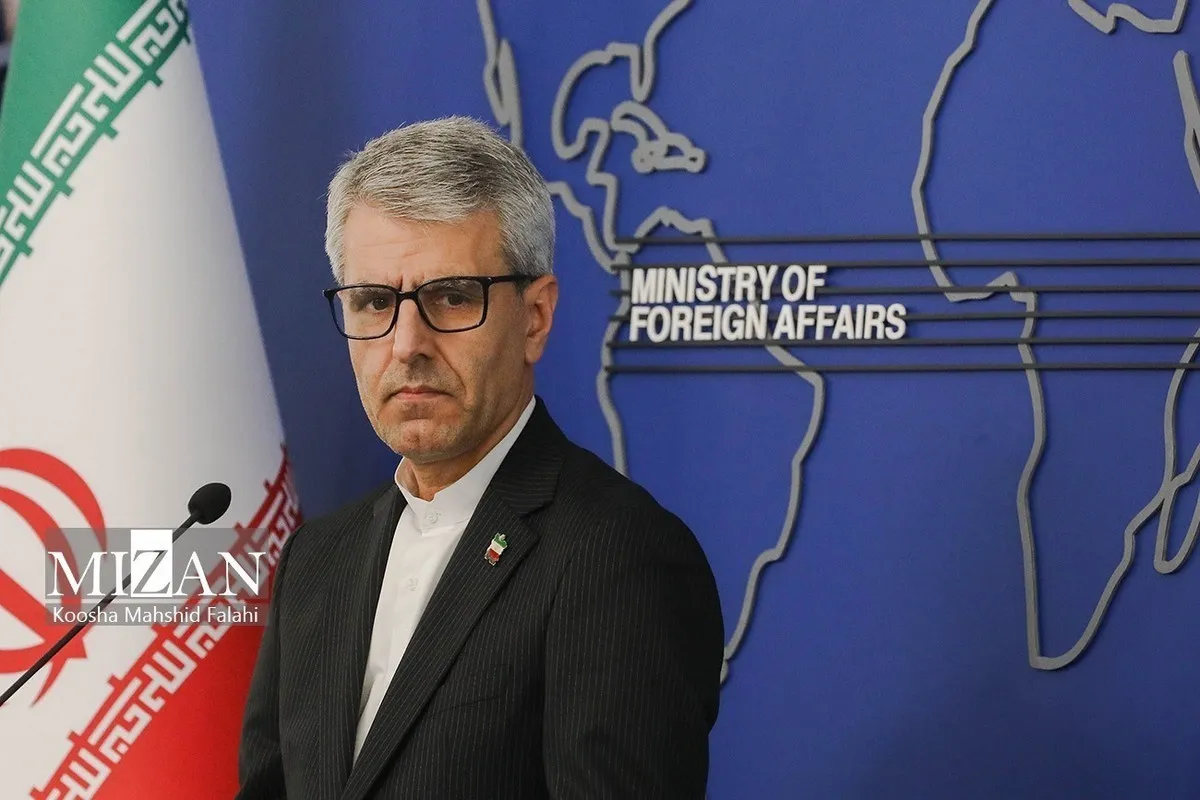
Esmaeil Baghaei, spokesperson for the Ministry of Foreign Affairs, on Sunday, December 7, 2025, addressed reporters from domestic and foreign media during the ministry’s weekly press briefing, answering questions on the most important recent developments in the field of foreign policy.
In response to a question from Mizan News Agency regarding reports about the second flight returning Iranian nationals from the United States and the mistreatment of detained Iranians there, Baghaei said:
“The return of some Iranians from the United States has apparently taken place on legal grounds and due to alleged violations of immigration laws—this is the claim made by the American side. However, we know that over the past year, racist actions against foreign nationals, particularly citizens of our region and especially Iranians, have intensified.”
He added: “Iranian nationals have been subjected to harassment under various pretexts.”
The Foreign Ministry spokesperson continued: “This is the second group that has been returned to Iran over recent months. The relevant procedures were carried out. We can understand that these Iranian citizens, after being subjected to considerable pressure by U.S. authorities, referred to our Interests Section in Washington and expressed their desire to return to their homeland. Naturally, any Iranian, wherever they may be in the world, is free to return to Iran whenever they wish. Our Interests Section provided the necessary facilitation, and in the coming days, around 50 to 55 Iranian nationals will return to Iran.”
Baghaei stated: “This is the reality of the matter. However, reports indicate that over the past year, more than 500,000 citizens from various countries have been returned to other countries or to their home countries under similar pretexts. In the case of Iranians, it is evident to us that these pressures are driven by political motives and by anti-immigration policies that are contrary to human rights laws.”
Regarding the statement by the Persian Gulf Cooperation Council reiterating claims over the three Iranian islands, Baghaei said: “Our position on the islands is historically and legally clear. There is no doubt whatsoever about Iran’s sovereignty over the three Iranian islands of Greater Tunb, Lesser Tunb, and Abu Musa. This statement merely repeats claims previously made in statements by the UAE and the GCC.”
He emphasized: “While we reject these claims entirely, it is natural for individuals—including journalists and domestic figures—to react to this issue related to national sovereignty and territorial integrity. Our recommendation to the Persian Gulf littoral states is to act in a way that does not play into the hands of the real threat to the region, namely the Zionist regime.”
Regarding the UK Supreme Court’s action in the Crescent case, the Foreign Ministry spokesperson said: “This matter has been followed from the outset by the Ministry of Petroleum and the Legal Deputy of the Presidency, and the Ministry of Foreign Affairs has spared no effort in assisting the relevant authorities in this regard.”
On Iran’s relations with the International Atomic Energy Agency and the recent consultations by Rafael Grossi, Director General of the IAEA, Baghaei stated: “We are in contact with the Agency. Our communications are direct and are mainly conducted through Iran’s representation in Vienna.”
Regarding Grossi’s recent consultations, he added: “It is not unusual for other parties to discuss the issue in their bilateral talks with Grossi, but there is no mediation or negotiation in the conventional sense.”
Emphasizing the direct nature of Iran’s relationship with the IAEA, he said: “A direct relationship does not require a mediator. Egypt and some regional countries are trying to help facilitate this process, and the phone call between the Iranian foreign minister and his Egyptian counterpart was made in this context.”
Regarding the message sent by Foreign Minister Seyed Abbas Araghchi to his Lebanese counterpart and the reaction from the other side, Baghaei said: “The issue of Iran’s interference in Lebanon is a misleading narrative. We do not interfere in Lebanon’s internal affairs. Hezbollah is a deeply rooted and influential part of Lebanese society and makes its own decisions regarding its policies.”
On Iran–U.S. negotiations, Baghaei said: “Our official communication channel with the United States in Iran is the Swiss Embassy, and for the Americans, it is Iran’s Interests Section in Washington.”
He emphasized: “There is no specific direct channel between us and the United States, but messages are exchanged through certain countries.”
The Foreign Ministry spokesperson stated that for the Ministry, the benchmark is national interest, which is defined by the relevant decision-making authorities. He explained: “The Ministry of Foreign Affairs formulates its positions based on assessments of conditions and in consultation with the relevant and influential bodies in the foreign policy apparatus. However, final decisions on major issues such as negotiations are made by higher-level institutions, such as the Supreme National Security Council.”
He added: “We examine criticisms of the Ministry of Foreign Affairs with openness and make use of them. Ultimately, decisions on major foreign policy issues are made in accordance with directives issued by higher-level authorities. Specifically, regarding negotiations with the United States, the Supreme National Security Council is the decision-making body.”
In another part of his remarks, Baghaei said: “We have no tolerance for violations against the country, and we have always warned regional and neighboring countries regarding the use of airspace.”
He emphasized: “We pursue these matters in a documented and legally substantiated manner, and if we receive verifiable evidence from the relevant national authorities, we raise the issue with the countries concerned.”