Secret Israeli tunnel project: Redrawing Jerusalem’s history by force
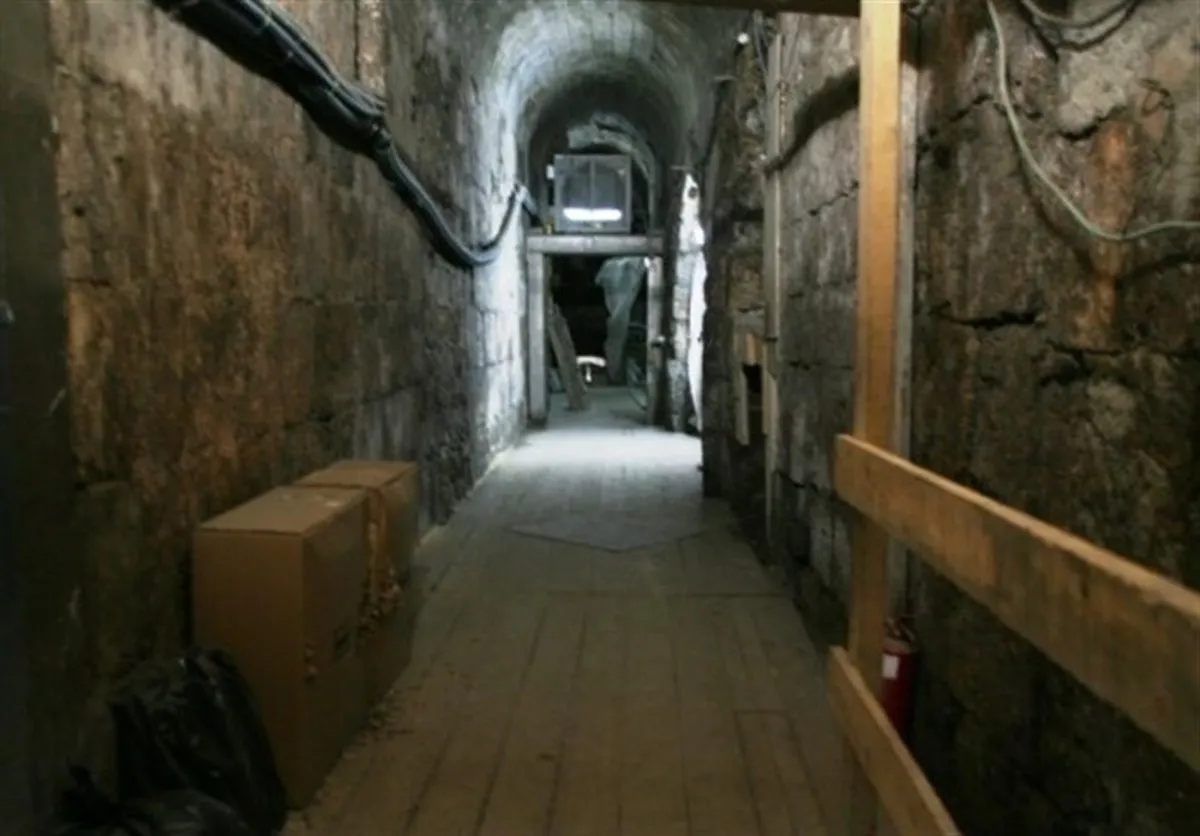
Through relentless excavations, the occupiers have accelerated their efforts to Judaize the area surrounding and beneath Al-Aqsa Mosque. About nine months ago, the Israeli regime began secretly digging a tunnel under strict security measures. The tunnel extends from al-Buraq Square in the west to the northwest wall of the mosque.
This tunnel, which is approximately 550 meters long, passes through Islamic, Canaanite, and Roman archaeological sites, posing a serious threat to irreplaceable historical structures. It also paves the way for the establishment of so-called “Torah Museums,” whose purpose is to alter the historical narrative of Jerusalem and link it to broader Judaization schemes in and around Al-Aqsa Mosque.
Fakhri Abu Diab, a member of the Committee of Al-Aqsa Trustees, told Al-Araby Al-Jadeed that the project is being carried out in complete secrecy. Access to the excavation site is restricted to workers from the Israeli Antiquities Authority, who are transported there under heavy security. Any attempt to approach the tunnel is prohibited, and monitoring progress is only possible from above and with great difficulty. The tunnel’s entrance has been reinforced with iron supports and covered with tents, making it impossible to see what is happening inside.
Abu Diab noted that “excavation work begins at dawn using heavy equipment, under a veil of secrecy and caution. The tunnel irregularly extends beneath the houses and shops of Jerusalem, posing a direct threat to the foundations of Al-Aqsa’s southwestern wall.” He added that Israeli authorities have not issued any official statement about these excavations in order to avoid negative reactions.
According to UNESCO standards, any alteration in this area is prohibited, particularly since Palestinian-owned properties still exist above it.
The seriousness of the project was heightened by a decision issued on July 16 by Meir Porush, the Israeli Minister of Jerusalem Affairs and Heritage, just hours before his resignation. The decision targeted nearly 20 historic and archaeological properties inhabited by Jerusalem residents. This indicates that the move was part of a broader plan to facilitate confiscations and prevent residents from protesting against the excavations—despite the fact that the area contains religious and historical structures dating back to the Mamluk era, including mosques, schools, and the office of the Supreme Islamic Council.
What is particularly concerning is that the tunnel has been designed to allow vehicles and heavy equipment belonging to settlers to pass directly beneath Al-Aqsa Mosque—something previously impossible due to the narrow alleys of the Old City. Completion of the project would therefore destroy irreplaceable historical landmarks.
The new tunnel also differs from previously discovered ones, as it begins inside the Old City and ends outside it, at Jaffa Gate Square. According to Abu Diab, this would allow the occupiers to bring large vehicles directly into the tunnel.
He explained that the purpose of the plan is to rewrite history and persuade visitors that this area has been Jewish for thousands of years. This, he warned, is a preliminary step toward connecting the area with the idea of constructing the so-called “Temple” in place of Al-Aqsa Mosque.
According to the Al-Quds International Foundation, the number of excavations and tunnels around and beneath Al-Aqsa Mosque is expected to reach nearly 64 by 2025. The foundation has warned of the “serious consequences these excavations pose to the stability of the foundations of the Noble Sanctuary.”
Abu Diab further noted that since the beginning of last year, the occupiers have launched over 20 new excavations. However, determining the exact number of tunnels remains difficult.
Meanwhile, Sheikh Ikrima Sabri, head of the Supreme Islamic Council in Jerusalem, said that Israeli authorities have carried out a series of excavations around Al-Aqsa Mosque in recent years. He noted that what is promoted as tunnels are, in fact, old water channels that were once used to collect water for the mosque’s cisterns or for surrounding homes.
Sabri explained that the occupiers traced and drained these channels, then expanded and linked them together, presenting them as a network of interconnected underground tunnels. Israeli authorities are now working to further enlarge and connect these cisterns in order to present them as a vast network that allegedly confirms the existence of “Jewish areas” beneath Al-Aqsa Mosque.
He stressed that control of underground water resources in Jerusalem is one of the main objectives of the occupiers. According to him, these activities are part of a broader scheme to seize Al-Aqsa Mosque and link it to the myth of the so-called “Temple,” as part of ongoing efforts to impose a fabricated historical narrative.