Gaza’s environmental collapse: A legacy of war and destruction
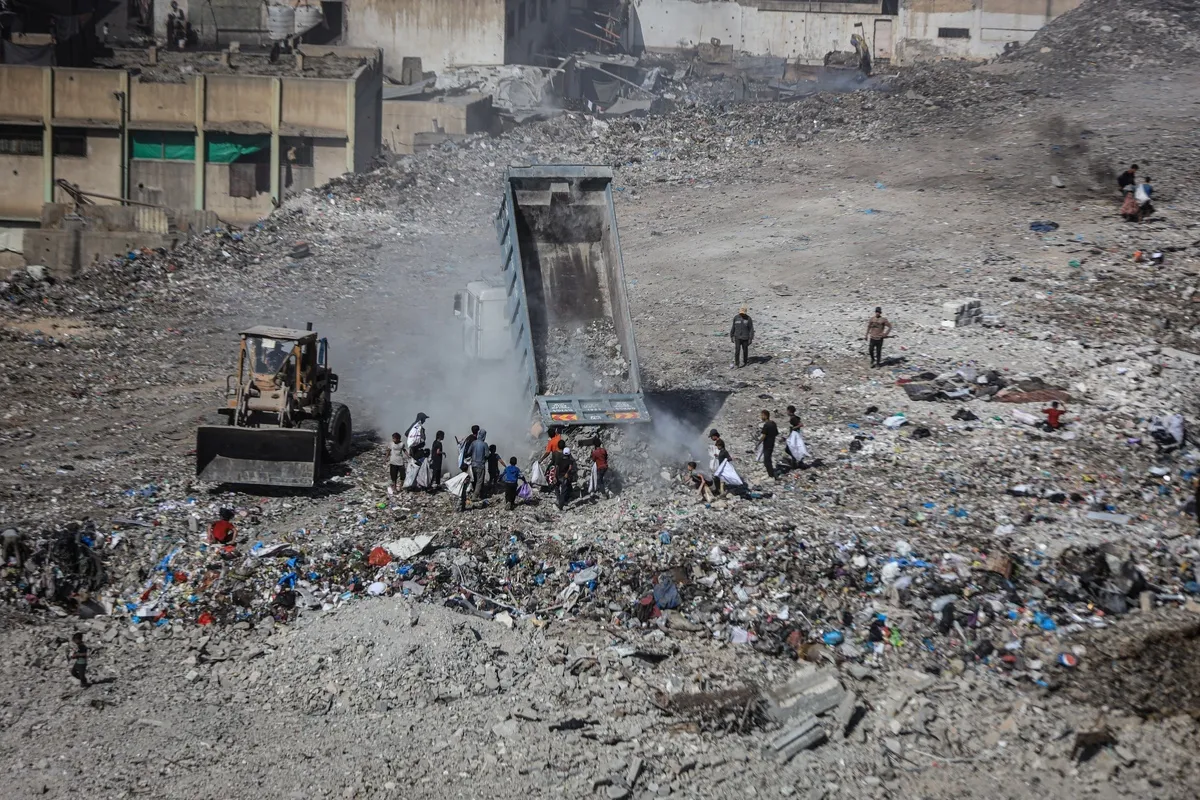
Since the start of the war on October 7, 2023, Israel has pursued ecocide as part of its genocidal strategy against the besieged territory.
Haaretz recently reported that the Israeli army has been transporting waste from occupied territories into Gaza. According to the report, trucks carrying large amounts of garbage and construction debris pass through the Kerem Shalom crossing into Gaza, unloading their loads in areas already devastated by the war. These trucks belong to private companies.
While Israeli army officers claim the decision to turn Gaza into a “mountain of waste and rubble” was made by field commanders, the military officially denies any knowledge of the matter.
One Israeli soldier currently stationed near the Gaza border stated: “Mountains of waste will remain in Gaza for the rest of our lives. What logic is there in dumping thousands of tons of waste just a few hundred meters from our homes?”
Another officer described the situation as shameful, saying he finds it hard to believe the army was involved. According to him, a senior official remarked that countries coming in to rebuild Gaza would have to deal with and manage the army’s waste.
The report also emphasizes the massive accumulation of construction waste left by the Israeli army from building dozens of bases and military positions near the Gaza border. These installations included infrastructure, fences, roads, and concrete barriers.
UN warning on Gaza’s environmental crisis
The Haaretz report comes as the UN Environment Programme (UNEP) released findings showing that approximately 250,000 buildings were damaged or destroyed during Israel’s war on Gaza, producing 61 million tons of debris.
The report notes that if waste streams are not properly sorted from the start, roughly 15% of this debris may carry high risks of asbestos, industrial waste, or heavy metal contamination.

UN assessments indicate that nearly two-thirds of Gaza’s waste was generated in the first five months of the war, with building destruction accelerating in the months leading up to the current ceasefire. Between April and July 2024, 8 million tons of debris were produced, mainly in the southern areas between Rafah and Khan Yunis.
Inger Andersen, Executive Director of UNEP, said ending the human suffering in Gaza must be the top priority. She stressed that restoring freshwater systems and clearing rubble to enable humanitarian access and the recovery of essential services is critical to saving lives. Restoring vegetation, freshwater ecosystems, and soil is also vital for food and water security and a better future for Gaza’s population.
Andersen warned that the worsening situation in the besieged region could leave a legacy of environmental destruction affecting the health and well-being of future generations.
The UN estimates that rebuilding Gaza will cost around $70 billion. Meanwhile, some reports suggest that the carbon footprint of Israel’s war against Gaza has extended beyond 100 countries.
Gaza: An environmental disaster zone
Gaza’s media office has declared the besieged region an “environmental and structural disaster zone” after two years of Israel’s genocidal war, which destroyed nearly 90% of civilian infrastructure and produced roughly 61.5 million tons of debris.

This volume of debris weighs roughly as much as 107 Shanghai Towers (the world’s second tallest building, weighing 575,000 tons) or 15 Romanian Parliament Palaces (the heaviest building in the world at 4.1 million tons). It also equates to more than 169 kilograms of debris per square meter across Gaza’s small territory.
Despite the fragile ceasefire, the lack of equipment and resources poses major obstacles to clearing the rubble.
Jaco Silers, UNDP representative in Palestine, said: “This is a very difficult process that will take years to complete.”
Clearing roads and recycling materials is the first stage of Gaza’s massive debris management plan, aiming to restore access to essential services such as hospitals and schools.
According to a relief organization, clearing unexploded ordnance could take 20–30 years, turning the area into a “terrifying and uncharted minefield.”
UN-led databases report over 53 fatalities and hundreds of injuries caused by remnants of the two-year war, though aid groups warn the real numbers are likely much higher.
The Palestinian Center for Human Rights (PCHR) has warned about the risks posed to civilians and debris removal efforts by unexploded munitions. An estimated 20,000 bombs, rockets, and missiles remain scattered across the rubble.
Although the ceasefire has brought some hope, the mission to clear Gaza remains a huge challenge for its people.