Baghaei: Iran remains a member of the NPT
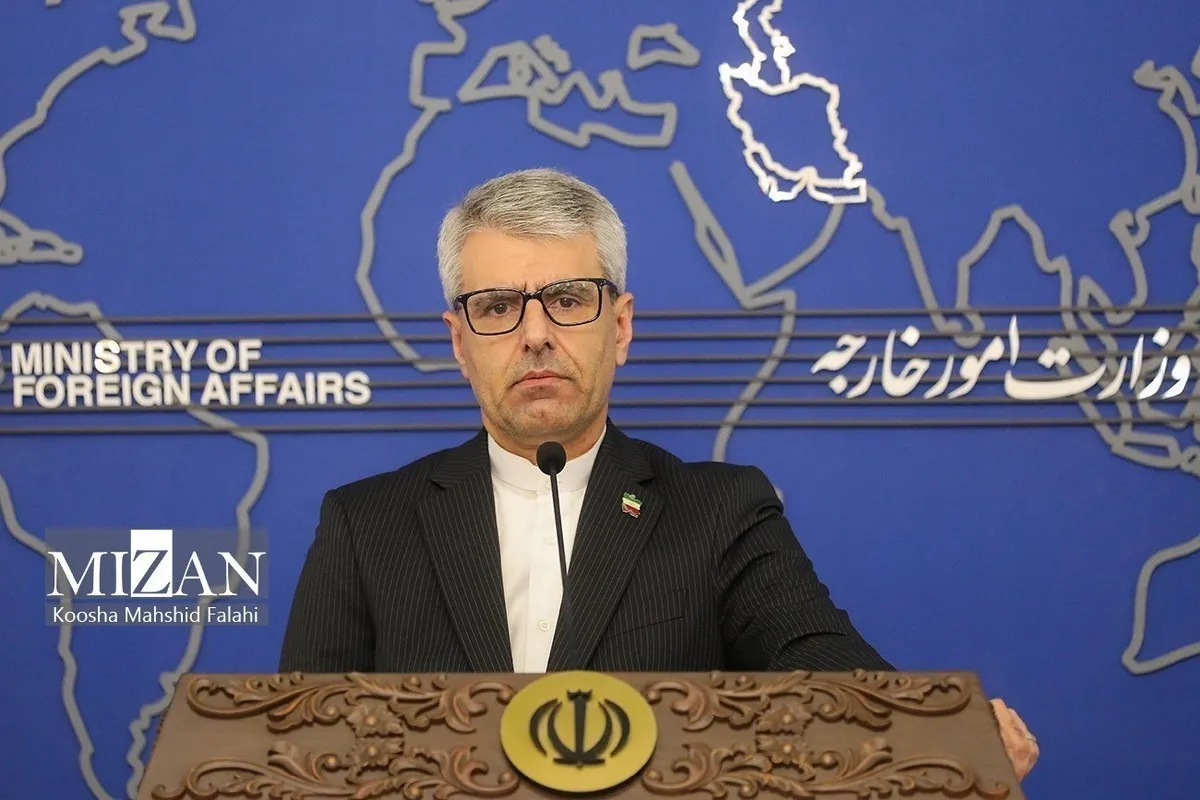
During his weekly press briefing on Tuesday, October 28, 2025, Foreign Ministry Spokesman Esmaeil Baghaei responded to questions from domestic and foreign media about the latest developments in Iran’s foreign policy.
Baghaei said that at the regional level, “we are still facing the ongoing crimes of the Zionist regime and the repeated violations of the ceasefire that was supposed to stop the killing of Palestinians.”
He added that multiple ceasefire violations have occurred in Gaza, while “the Zionist regime continues its aggression against Lebanon, aimed at obstructing Lebanon’s economic development.”
He stressed that “the lack of accountability encourages Israel to further violate human rights and humanitarian law,” adding that “the UN Security Council remains paralyzed.”
Commenting on U.S. President Donald Trump’s recent remarks describing Israel as a proxy, Baghaei said: “The reality is that whatever the Zionist regime does in our region — whether in Gaza or Lebanon — bears America’s name, as there is no doubt about Washington’s military, political, and arms support for this regime. Israel’s impunity has made it increasingly difficult even for its own backers to restrain it.”
He added that the international community “must not only pressure the Zionist regime but also its allies — particularly the United States — to end this cycle of impunity.”
Regarding the Gaza ceasefire, Baghaei said Iran “welcomes any halt to the genocide in Gaza,” but remains “deeply concerned about ambiguities in the agreement and Israel’s repeated violations.” He noted that Israel “has committed numerous ceasefire violations in both Gaza and Lebanon.”
On the case of Mahdieh Esfandiari, an Iranian citizen detained in France, Baghaei said she received conditional release under supervision following a court session on October 21.
“We welcomed this development,” he stated, “as there was no legitimate reason for her arrest. We hope this ruling will lead to her full acquittal and return to Iran.”
He said Iran’s ambassador in Paris “has been seriously following up the matter, and this process will continue until her complete release.”
Asked about a potential prisoner exchange between Iran and France, Baghaei said: “Whenever Ms. Esfandiari is freed, an exchange may be possible. Her arrest was an example of arbitrary detention. We expect the next court session in December or January and hope it will result in her full release.”
Discussing relations with the International Atomic Energy Agency (IAEA), Baghaei said: “Following recent developments, our cooperation with the Agency is based on the law passed by the Iranian parliament. We remain a member of the NPT and are committed to the Safeguards Agreement. Implementation of these safeguards continues under the oversight of the Supreme National Security Council.”
He emphasized that some cooperation with the IAEA “serves Iran’s national interests,” citing collaboration on the Bushehr nuclear power plant and the Tehran Research Reactor.
“The scope of our cooperation is defined by international law,” he said. “Like any other country, our engagement with the Agency is based on the NPT and the Safeguards Agreement. When UNSC Resolution 2231 was in place, we accepted certain transparency measures to facilitate the lifting of unjust sanctions. The current situation is clear, and our relations with the Agency are not in limbo.”
Referring to recent remarks by Deputy Foreign Minister Majid Takht-Ravanchi, Baghaei said his comments were “misconveyed.” “In general terms,” he said, “the possibility of U.S. military aggression has always existed based on our historical experience. The United States carried out military actions against Iran even during the eight-year imposed war.”
He added: “Remaining in a constant state of readiness is a sign of foresight and prudence. We did not expect to be attacked in the middle of negotiations, but instead of blaming ourselves, we should highlight the gravity of U.S. crimes. In all diplomatic engagements, we must learn from past experiences.”
Regarding the upcoming IAEA Board of Governors meeting and Director-General Rafael Grossi’s claims about enriched materials, Baghaei said: “Iran’s permanent mission in Vienna maintains direct contact with the Agency. Ongoing communication with the IAEA is routine and normal.”
Addressing legal follow-ups on U.S. and Israeli aggression against Iran, Baghaei explained that “the first step in any international legal action is documentation.”
He said Iran began collecting evidence “from the very first day of the aggression,” adding that the Foreign Ministry, alongside the Judiciary and the Presidential Legal Office, is involved in this process.
In response to a question about U.S. and Israeli actions against the International Court of Justice (ICJ) and UNRWA following the ICJ’s advisory opinion on Gaza, Baghaei said:
“The ICJ is a UN body for dispute resolution with a defined legal standing. Washington’s attitude toward both the ICJ and the International Criminal Court shows its commitment to maintaining Israel’s impunity. The U.S. government’s threats and attempts to undermine these international institutions reveal its complicity in Israel’s crimes.”
He stressed: “As long as Israel’s impunity continues, it will not be held accountable before the international community and will persist in committing atrocities.”
On recent remarks by Foreign Minister Seyed Abbas Araghchi regarding talks with the U.S., Baghaei said: “Whenever we determine that the conditions are right and our interests and rights are guaranteed, we will not hesitate to engage in dialogue.”
He added: “The Foreign Ministry is not dependent on a single process. The nuclear issue was imposed upon us — it should not have been referred to the Security Council in the first place, but due to international circumstances, we must address it diplomatically.”
Referring to the visit of Ali Larijani, Secretary of Iran’s Supreme National Security Council, to Russia, Baghaei said the trip was “part of ongoing consultations between Tehran and Moscow, covering a wide range of topics.”
He said discussions included implementation of the bilateral cooperation roadmap and other key issues of mutual interest.
Baghaei noted that Russia reported Israel had raised the issue of de-escalation. “We receive contradictory messages from different parties,” he said. “Based on experience, we know we must always remain prepared. Israel does not abide by its claims or promises. Our full focus is on strengthening national defense and deterrence capabilities.”