Disease, sewage, and thirst: Gaza’s war beyond the airstrikes
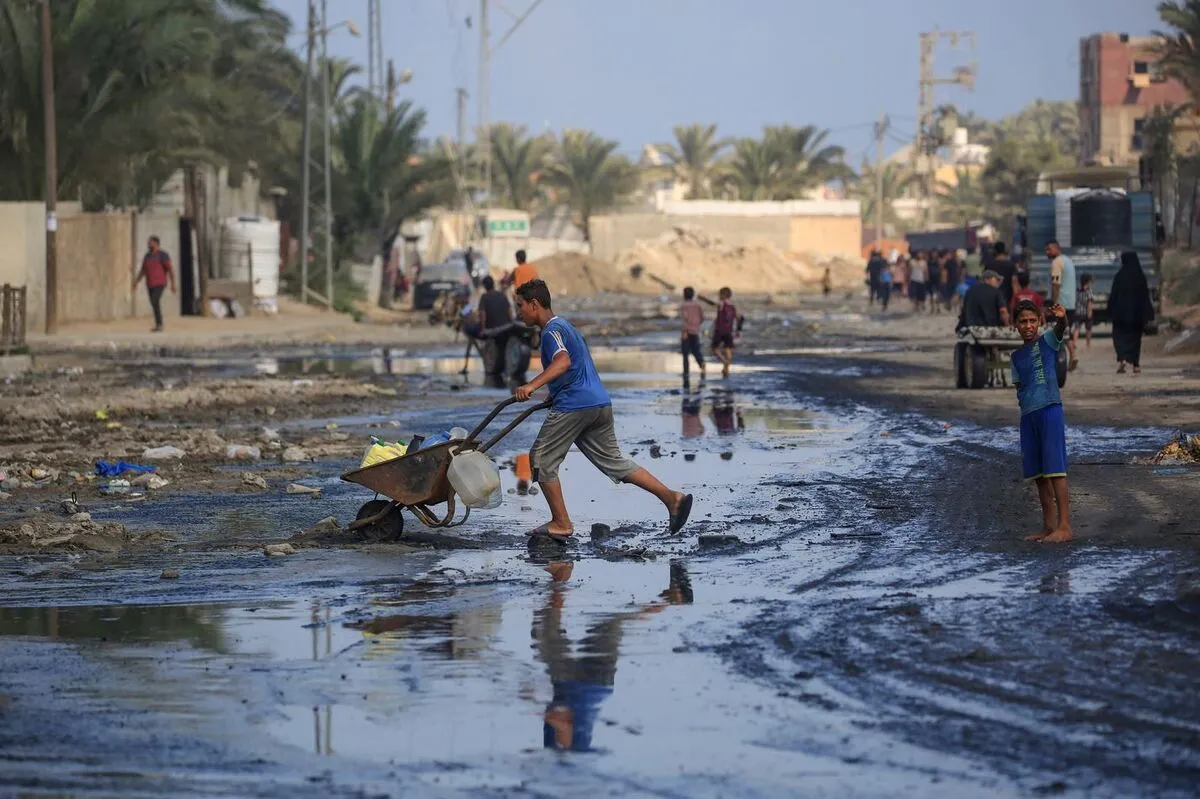
Since the start of its war on Gaza, Israel has destroyed much of the territory’s water infrastructure. Now, residents are struggling with a severe lack of safe drinking water, sewage overflows, contamination, and scorching heat.
Agence France-Presse (AFP) reported on Monday that beyond the airstrikes, displacement, and hunger, an unprecedented water crisis is sweeping across Gaza—intensifying the suffering of its residents.
Even before the war began roughly 22 months ago, Gaza faced a water crisis. But Israel’s destruction of over 80% of the territory’s water infrastructure has left the situation far worse.
Um Nidal Abu Nahl, a mother of four from Gaza City, told AFP: “Sometimes I feel like my body is drying up from the inside. Thirst drains all the energy from me and my children.”
According to the report, at times water trucks manage to reach residents, and NGOs have installed taps in some camps for a limited number of people. But these measures are nowhere near enough.
After cutting off water supplies in the early days of the war, Israel connected some of Gaza’s main northern water pipes to the Israeli water company Mekorot. Yet residents told AFP that the water still isn’t flowing.
Local officials say this is due to war-related damage to Gaza’s water distribution network, as many of the main pipelines have been destroyed.
Assem al-Nabih, a spokesperson for Gaza’s municipality, told AFP that parts of the municipal water network supplied by Mekorot have been out of service for nearly two weeks.
Wells that previously supplied part of Gaza’s water needs have also been damaged, and some have been contaminated by untreated sewage as a result of the war.
Many of Gaza’s wells are now practically inaccessible—located in active combat zones, dangerously close to Israeli military installations, or in areas under evacuation orders.
In any case, wells usually rely on electric pumps. But as part of its war strategy, Israel has cut Gaza’s electricity supply, leaving energy extremely scarce.
AFP noted that generators could power the pumps, but hospitals are prioritized for the limited fuel available.
Ultimately, Gaza’s desalination plants have also been shut down—except for one facility that was restarted last week after Israel temporarily restored electricity.
A flood of sewage
The Gaza municipality spokesperson told AFP that the state of the strip’s infrastructure is catastrophic: more than 75% of wells are out of service, 85% of public service equipment has been destroyed, 100,000 meters of main water pipes have been damaged, and 200,000 meters of sewage networks are unusable.
Pumping stations have been shut down, and 250,000 tons of garbage are blocking streets.
Meanwhile, Mohamed Abu Sakhila from the northern city of Jabalia said, “Because of the destroyed infrastructure, sewage is flowing into the areas where people live.”
Hundreds of thousands of people are still trying to find water, drawing directly from underground aquifers.
However, Gaza’s coastal groundwater is naturally salty, with salinity levels far exceeding permissible standards for drinking water.
UNICEF warned in 2021 that nearly 100% of Gaza’s groundwater was unfit for human consumption.
Disease outbreak
Although Gaza’s water crisis has received less media coverage than its hunger crisis, its consequences are just as deadly.
Rosalia Bollen, a UNICEF spokesperson, stressed that “just like food, water should never be used for political purposes.”
She told AFP that while it’s difficult to measure the exact scale of the shortage, “there is a severe lack of drinking water.”
Bollen warned: “The weather is extremely hot, diseases are spreading, and water is something we really aren’t talking about enough.”
The report emphasizes that opportunities to access clean water are as rare as they are dangerous.
Gaza’s Civil Defense Agency reported that on July 13, when crowds had gathered at a water distribution point in the Nuseirat refugee camp, at least eight people were killed in an Israeli attack.