Seraj meets with UN Deputy High Commissioner for Human Rights
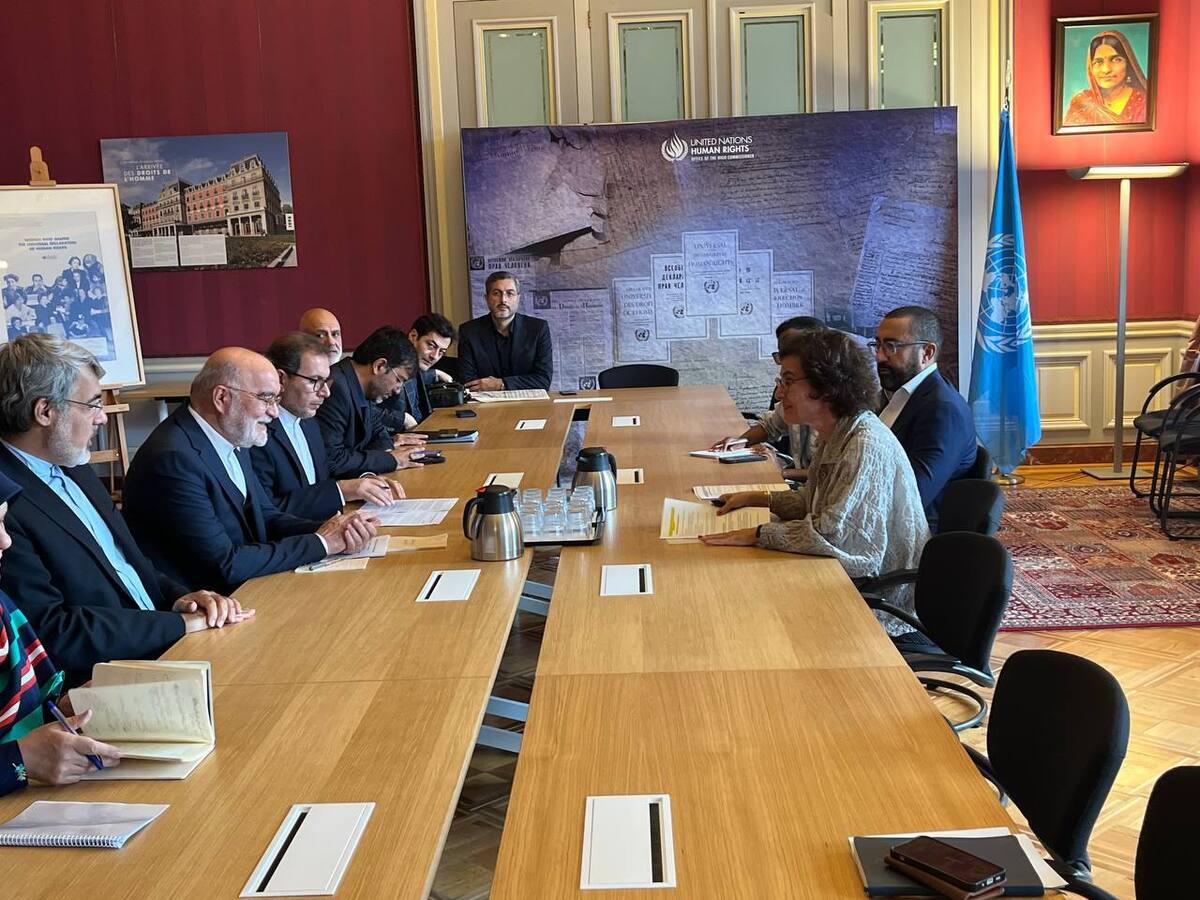
During the meeting, the two sides discussed bilateral cooperation and interaction in the field of human rights.
Present at the meeting were Bahreini, Iran’s Ambassador and Permanent Representative in Geneva; Sargazi, Head of the Legal and Judicial Commission of Parliament; Vadiati, Director General of Human Rights at the Ministry of Foreign Affairs; as well as several families of martyrs of the 12-day imposed war.
The Secretary of Iran’s High Council for Human Rights emphasized the Islamic Republic of Iran’s commitment to constructive cooperation with human rights institutions. Referring to past interactions, including the exchange of delegations and joint workshops in Tehran and Geneva, he called for a professional and non-politicized approach by the Office of the High Commissioner for Human Rights.
Seraj criticized the “unfair conduct” of the Fact-Finding Mission regarding the 2022 unrest in Iran and the extension of its mandate, describing its unsubstantiated reports as damaging to the credibility of the United Nations.
He also criticized the lack of firm condemnation of the Israeli regime’s and the United States’ aggressions against Iran, particularly during the nuclear negotiations, and called for explicit condemnation of such violations and accountability for the perpetrators.
He stated that Iran’s strategy is based on constructive engagement, substantive cooperation, and multicultural universality, expressing hope that cooperation with the Office of the High Commissioner for Human Rights would be expanded.
Seraj described the attacks by the Israeli regime and the United States on Iran’s nuclear, media, health, and prison facilities, as well as on residential and rural areas, as a clear violation of international law. According to official reports, he said, these attacks up to July 15, 2025, resulted in over 1,062 martyrs and 5,800 injured, including 45 children and adolescents, 102 women, and 14 scientific elites.
He added that the silence and inaction of states in the face of violations of peremptory norms of international law make them internationally responsible, and he called for urgent, effective, and coordinated action by states and international institutions—particularly UN human rights mechanisms—to address these ongoing violations that threaten global peace, security, and human rights.
Both sides emphasized the necessity of constructive engagement and avoiding politicized or selective approaches in the field of human rights.
At the conclusion of the meeting, Seraj presented Al-Nashif with a book of human rights documents of Iran’s Judiciary, and both sides agreed on the need for a non-politicized approach to human rights issues.
Families of the martyrs of the 12-day imposed war also called on bodies such as the Office of the High Commissioner for Human Rights to adopt a clear stance and take practical action regarding the crimes committed by the Israeli regime.