Sexual violence, torture, and silence: The hidden reality of Israeli prisons
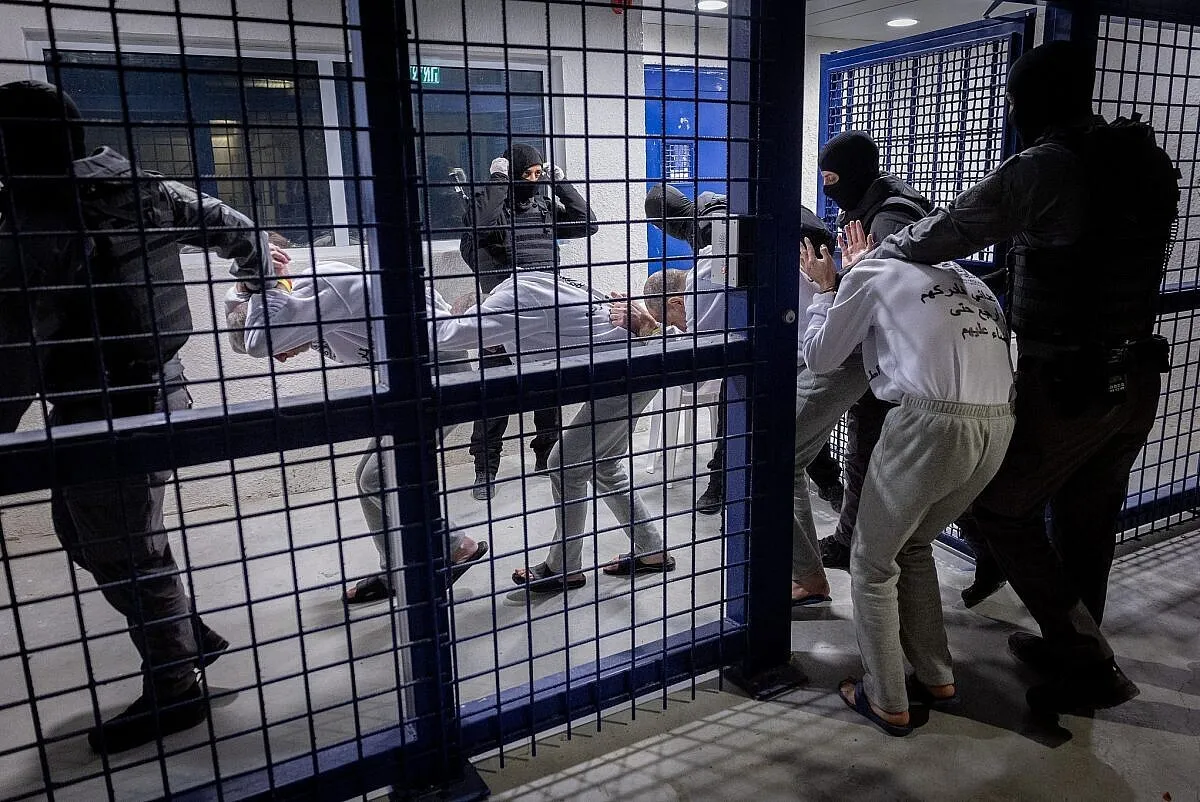
“Even the movement of shadows terrifies me.” This is how Saber, a 45-year-old Palestinian prisoner from the city of Qalqilya in the northern West Bank, describes his condition. According to his own account, in November 2023 he became a victim of sexual assault by prison guards inside Israeli prisons. His family name has been withheld for security and privacy reasons.
According to a complaint filed by Saber in July 2024 through his lawyer, Wiam Baloum, to the Israeli police — a copy of which was obtained by Al-Araby Al-Jadeed — the prisoner was subjected to severe abuse over two consecutive days. Saber emphasized that he was not the only victim and that two other prisoners were assaulted at the same time, under the supervision of a senior prison officer.
The complaint called for Saber’s transfer from the Negev Prison to prevent retaliation, the initiation of judicial proceedings, and the provision of medical and psychological treatment. However, none of these demands were met. Israeli police ultimately closed the case, citing a “lack of sufficient evidence,” a move that Saber’s lawyer described as clear proof of collusion between Israel’s security and judicial institutions.
As criticism mounted, prison authorities adopted a new policy: removing officers’ names from their uniforms and replacing them with numbers, thereby reducing the ability to identify and legally pursue them.
Tracking the perpetrators online
Despite these restrictions, the author of this report was able to identify the identities and images of several officers named in Saber’s complaint through tracking social media accounts. Among them is Raz Fasker, a senior officer at Negev Prison, who lists himself merely as a “government employee” on his personal accounts while simultaneously sharing photos of his foreign travels, including a trip to Germany.
The identities of two other officers at Ofer Prison near Ramallah have also been identified. According to testimonies from nine released prisoners, these officers played a direct role in the torture and abuse of detainees, particularly prisoners from Gaza.
The scope of a systematic pattern
According to statistics from the Palestinian Commission of Detainees and Ex-Detainees Affairs, as of October 7, 77 Palestinian prisoners had died as a result of torture in Israeli prisons, while the fate of dozens of others remains unknown.
A report by the Palestinian Prisoners’ Club marking the second anniversary of the start of the war confirms that sexual assault — alongside torture, starvation, denial of medical care, and the deliberate spread of disease — has become part of a systematic pattern of violations against prisoners’ rights. According to the organization, this pattern continues under judicial cover, even at the level of Israel’s Supreme Court.
Lima Bastami, head of the legal department at the Euro-Mediterranean Human Rights Monitor, says that despite extensive obstacles within Israel’s judicial system, international prosecution remains possible through the International Criminal Court and the principle of universal jurisdiction. According to her, international law focuses not on the identity of perpetrators, but on the nature of the crimes committed.
However, she stresses that the lack of political will within the Palestinian Authority remains one of the main obstacles to effectively advancing these cases, causing many efforts to stall at the complaint-registration stage.
Fear of retaliation
According to Amani Sarhanah, media officer of the Palestinian Prisoners’ Club, at least 11 cases of sexual assault in Israeli prisons have been documented as of December 12. Nevertheless, many victims refrain from pursuing legal action out of fear of retaliation, re-arrest, or threats against their families, seeking only psychological treatment.
The case known as the “Sde Teiman scandal,” which led to the resignation of Israel’s military prosecutor, is cited as an example of such pressure, where the victim was not even allowed to provide formal testimony.