Ceasefire in name only: Israel continues bombing schools sheltering Gaza’s displaced
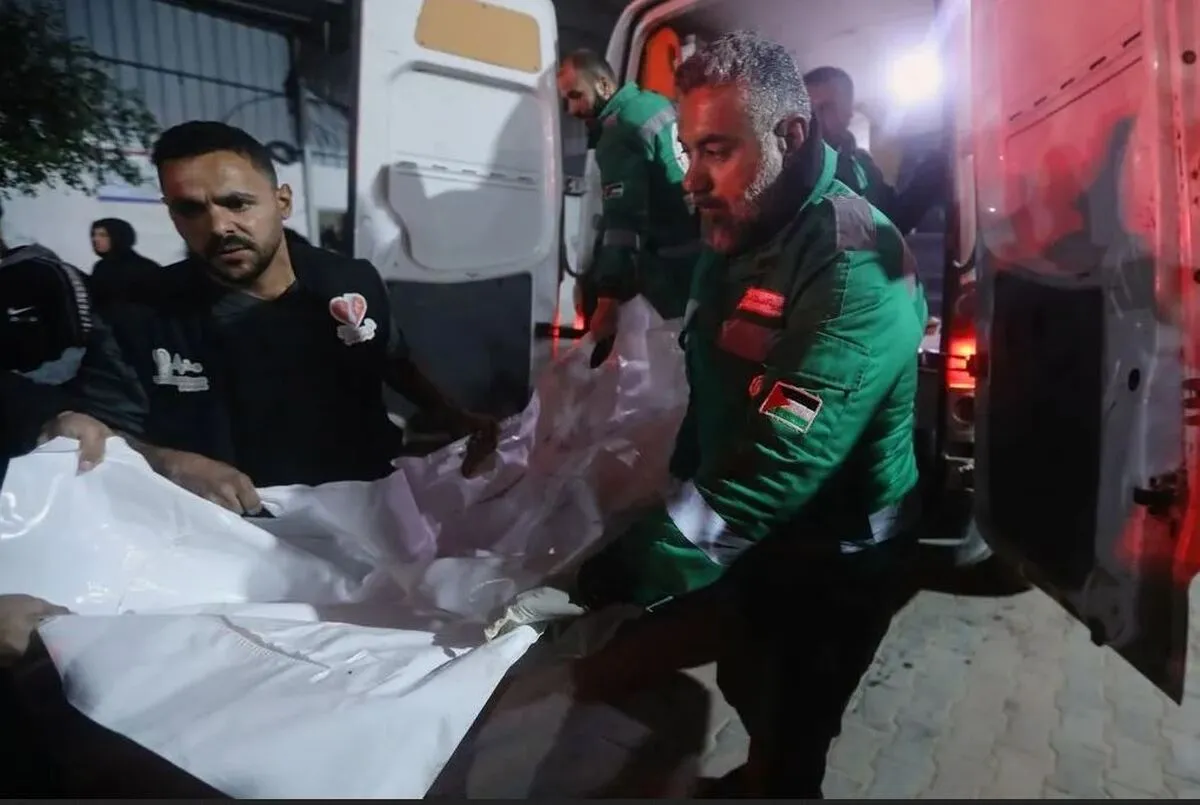
On Friday, December 19, 2025, the Israeli army targeted a school housing displaced Palestinians in Gaza.
According to medical sources and witnesses to the crime, the attack struck a school near Mohammed al-Durra Hospital in the eastern al-Tuffah neighborhood of Gaza—a school that had been serving as a shelter for displaced Palestinian families.
Local sources reported that the attack later expanded to include an educational building belonging to the Ministry of Education, located opposite al-Durra Hospital.
Horrifying videos have been published showing the aftermath of the bombing of the school sheltering displaced Palestinians in Gaza; the footage shows terrified people carrying and evacuating the wounded.
Some witnesses reported finding dismembered bodies of the martyrs. One of the hospitals receiving the wounded from this criminal attack announced that one of the martyrs was an infant.
According to the latest reports, at least seven people were killed in the attack. The Palestinian Emergency Services stated that most of the martyrs were children, and that a number of the wounded were transferred to hospitals for treatment.
Emergency services also said they were only able to recover the bodies of the martyrs after coordinating with the UN Office for the Coordination of Humanitarian Affairs and the Zionists.
While admitting responsibility for the attack on the school sheltering displaced Palestinians in Gaza, the Israeli army repeated baseless claims it has consistently used over the past two years of war against the enclave to justify its genocidal crimes.
Despite the ceasefire, Palestinian health officials say that Israeli attacks have continued across the Gaza Strip.
According to the Palestinian Ministry of Health, with the inclusion of the victims of this latest criminal attack, the number of Palestinians killed by Israel in Gaza since the ceasefire began in October has reached 400.
In a statement, the Islamic Resistance Movement Hamas said that the artillery attack by the Zionist occupation army on a school sheltering displaced persons in the al-Tuffah neighborhood of eastern Gaza City—which resulted in the killing of a number of citizens, especially children—constitutes a brutal crime against civilians and a clear and repeated violation of the ceasefire agreement.
The statement added that the Israeli cabinet, by continuing to deliberately target civilians in the Gaza Strip for more than two months since the announcement of the ceasefire, has caused the deaths of more than 400 Palestinians, with these actions continuing amid the silence and inability of the international community.
Hamas also stressed that occupation forces have worsened the humanitarian crisis by preventing ambulances and medical personnel from accessing attack sites and obstructing rescue and relief operations, describing this as a blatant violation of international humanitarian law.
The movement called on mediators to play their role and urged them to intervene to curb the efforts of the cabinet of Israeli Prime Minister Benjamin Netanyahu to impose arrangements contrary to the provisions of the agreement and to openly violate it.
Since the start of the war on Gaza in October 2023, Israel has targeted the enclave’s vital infrastructure.
One of the most alarming aspects of this war has been the repeated attacks on schools in Gaza, which are often used as shelters for the displaced, as schools quickly became temporary refuges following the outbreak of the war.
The United Nations Relief and Works Agency for Palestine Refugees (UNRWA) reported that many of these schools—more than 500—were being used as emergency shelters.
These schools were often managed by the United Nations and flew UN flags, but this did not prevent Israeli attacks.
In a report published in August 2025, Human Rights Watch emphasized that Israeli attacks on shelter schools have increased risks to civilians and demonstrate the absence of safe places in Gaza.
According to reports by credible international organizations such as the United Nations, Human Rights Watch, and UNICEF, these attacks not only constitute violations of international humanitarian law but also appear to be part of a systematic pattern aimed at the forced displacement of Gaza’s population.
Assessments indicate that from the start of the war on Gaza until December 20, 2025, Israel bombed more than 430 schools that were sheltering displaced persons.
At the same time, UN data showed that by March 2024, more than 212 schools had been directly attacked by Israel, many of which were shelters for the displaced.
This pattern continued into 2025, with subsequent reports indicating an increase in such attacks. According to UNOSAT (the UN Satellite Centre) reports from July and November 2025, out of 564 schools in Gaza, 432 (around 77 percent) were directly hit, and 548 (97 percent) were damaged or destroyed.
Most of these schools were being used as shelters for displaced people at the time of the attacks, as more than 87 percent of Gaza’s schools have been damaged or destroyed and the education system has been completely halted.
Numerous specific cases have been documented. For example, in April 2025, Israel bombed three schools in Gaza that were sheltering families, killing at least 18 children.
In May 2025, an attack on a school in Gaza resulted in the killing of 54 displaced Palestinians.
In June 2025, The Guardian reported that these attacks were part of a deliberate Israeli strategy to bomb schools used as shelters.
An independent UN commission reported in July 2025 that many schools were attacked multiple times, often while they were serving as shelters for displaced persons.
According to the Israeli human rights organization B’Tselem, by December 2025 Israel had issued at least 161 evacuation orders, many of which resulted in the bombing of shelter schools.
These bombings have had devastating impacts, a phenomenon described as “scholasticide,” meaning the systematic destruction of the education system.
UNRWA reported that Gaza’s schools are used as shelters, yet attacks on them continue.
UN experts have described these attacks as assaults on children and violations of the right to safe education.
From a legal perspective, these attacks may constitute war crimes; a UN commission reported that attacks without warning on shelter schools violate international law.
While UNESCO has called for an end to Israeli attacks on these schools, Human Rights Watch has stressed that such attacks increase risks to civilians and must be investigated.
Israeli attacks on Gaza’s schools—which continue even during a ceasefire—appear to be part of a broader pattern of forced displacement and destruction of infrastructure. This crisis affects not only the current generation in Gaza but also threatens the future of Palestinians.
There is an urgent need for independent investigations and immediate accountability to put an end to this trend and to ensure that such crimes are not repeated.