Post-Assad Syria: Damascus on the brink of instability
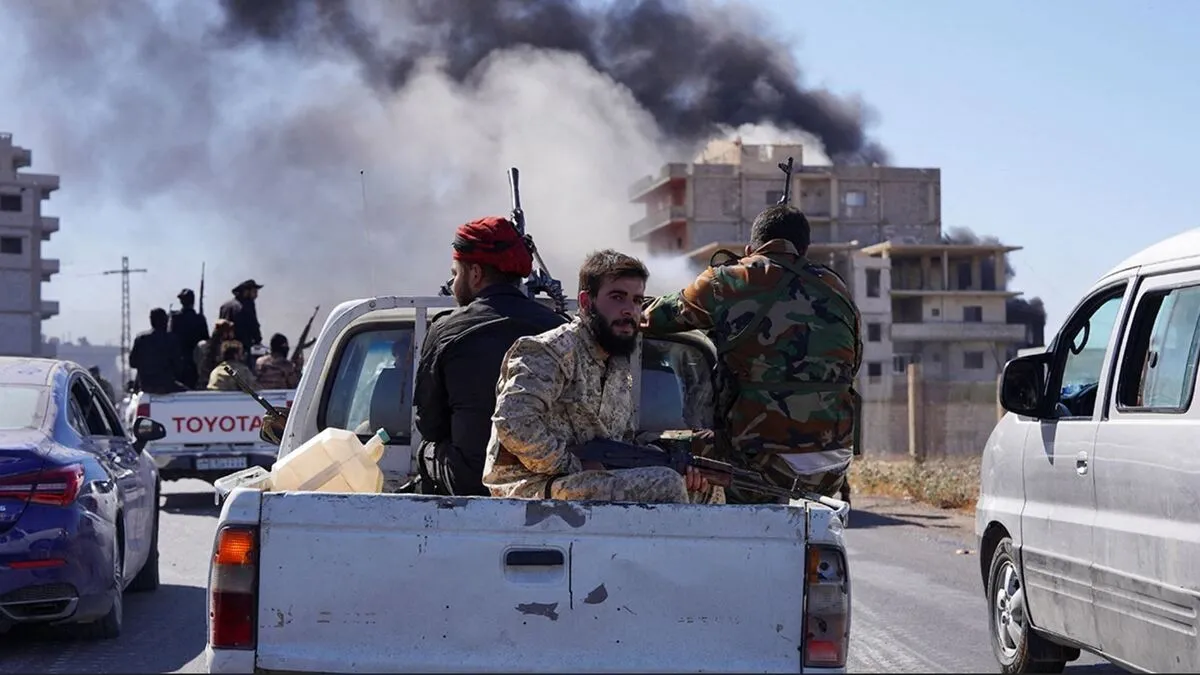
In December 2024, Syrian armed groups began movements from several provinces, including Idlib, and quickly advanced toward Damascus, the capital. This advance faced little resistance from the Syrian army, allowing the groups to reach the gates of Damascus within days.
On December 9, 2023, Syrian media reported that armed groups had entered Damascus and seized several government buildings, including the Syrian Radio and Television headquarters.
A week later, on December 17, 2023, the Syrian presidential social media account published a statement attributed to Bashar al-Assad. Following the fall of Assad’s government, Syrian media reported that Mohammed Al-Bashir was tasked with forming a new government to manage the transitional phase.
The new Syrian government appointed a new foreign minister—Asaad Hassan Al-Sheibani, selected by armed groups—and eventually Ahmed Al-Shara was appointed as the head of the transitional government.
Now, one year into the rule of Damascus’ current leadership, the country has not moved toward stability or calm, but faces numerous challenges.
Cycle of instability in Syria
Hassan Hanizadeh, a regional expert, told Mizan that one year after the overthrow of Assad’s government, Syria has entered a cycle of security instability and internal crisis.
He noted the widespread suppression of minority groups, stating that many Syrian Alawites were assassinated by terrorist groups affiliated with Hay’at Tahrir al-Sham, and many scholars and elites were identified and killed with the tacit approval of the U.S. and Israel. This, he said, shows that the overthrow of Assad’s government aimed to remove Syria from regional and international equations.
Ahmed Al-Shara and coordination with Israel
Hanizadeh also noted that over the past year, Israel has occupied hundreds of kilometers around the Golan Heights and Mount Hermon, indicating that the current Syrian government lacks sufficient deterrence against Israel and, in many regional and global issues, coordinates with it.
He emphasized that creating a government dependent on the U.S. and Israel was part of Western objectives to replace Assad’s government with one loyal to them. He also warned that public dissatisfaction in Syria has significantly increased.
Turkey-Syria relations
Hanizadeh highlighted Turkey’s role in Assad’s ouster, noting that Turkey played a logistical and strategic role, occupying parts of Idlib since 2016, turning it into a base for opposition against Assad.
He added that the current Syrian government is highly dependent on Turkey, and the government may cede parts of Idlib to Turkey, which could impact Syria’s territorial integrity.
Recent Events in Beit Jen and Popular Resistance
Regarding clashes between Israel and residents of Beit Jen, a Damascus suburb, Hanizadeh said security instability and popular resistance are emerging in Syria.
He explained that Hay’at Tahrir al-Sham affiliates have executed former Syrian officials without trial, prompting societal responses against killings targeting various communities. He concluded that Syria has entered a cycle of insecurity and sectarian confrontation.
Israeli intervention in Suwayda
Hanizadeh pointed out that Israel has intervened in Suwayda under the pretext of protecting the Druze minority, which he called a blatant interference in Syria’s internal affairs. He noted that Druze communities had historically enjoyed security and government roles under Assad but are now threatened, potentially leading to the fragmentation of this part of Syria.
Alawites and social structure
Hanizadeh emphasized that Alawites, a key social component of Syria, have faced suppression in the past year. Under Hafez and Bashar al-Assad, Alawites had entered the power structure; now, after Assad’s fall, they are targeted by extremist terrorist groups. He warned that hundreds of Alawites have already been killed, signaling a potential civil conflict similar to Lebanon in the 1970s or Sudan.
U.S. position on Syria and contradictions
Hanizadeh criticized the U.S. role in Syria, highlighting Ahmed Al-Shara’s meetings with American officials, including Donald Trump. He described it as absurd that Al-Shara, a wanted individual and former terrorist leader with a $10 million bounty, is now welcomed as the head of a Syrian government.
He concluded that the U.S. has used terrorists as instruments to change regional dynamics, imposing Al-Shara over Syria, disregarding human rights, and using counterterrorism selectively as a political tool.