The hidden toll of Israel’s war: Gaza’s missing and the struggle for identification
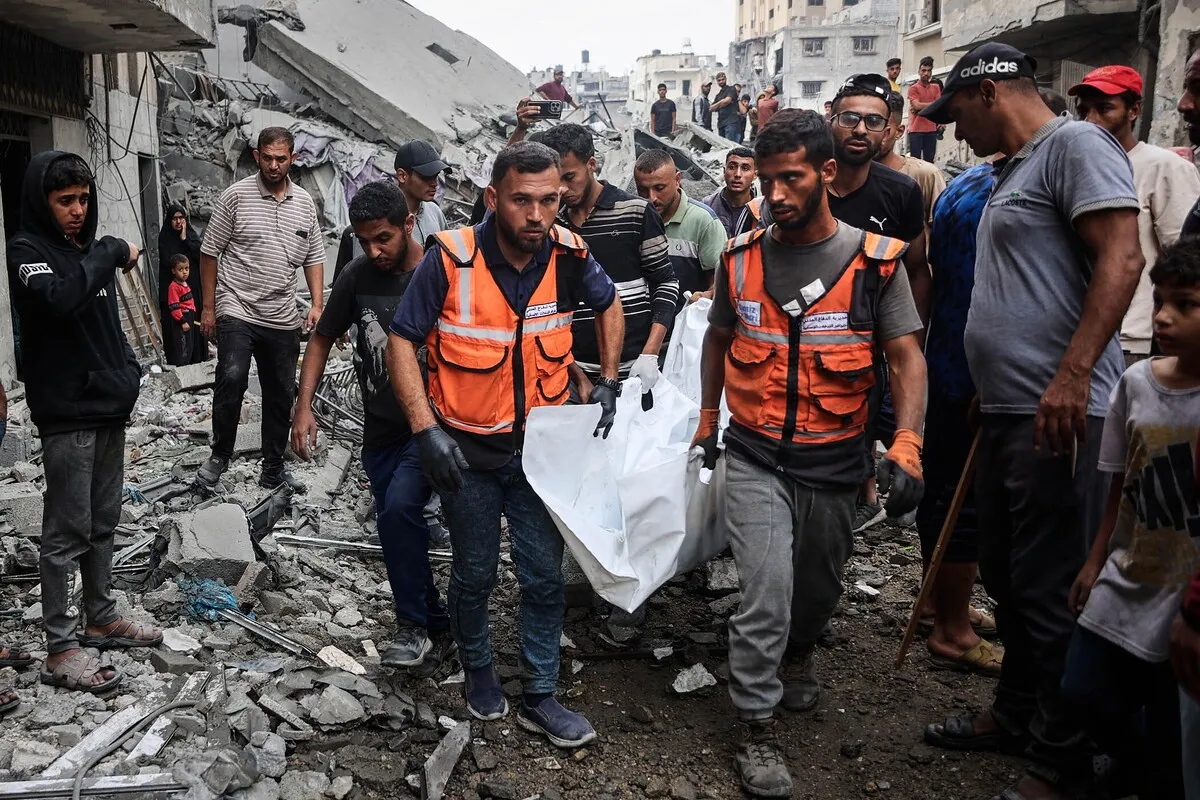
Over 11,000 Palestinians, mostly women and children, have gone missing since Israel began its war on Gaza in October 2023. The families of the missing have no idea whether their loved ones are alive, dead as a result of Israeli attacks, or imprisoned inside Israel’s detention facilities.
According to a report by +972 Magazine, citing UN data, more than 11,000 Palestinians have disappeared during the two-year war on Gaza. The UN stated that most of these individuals are women and children who may be trapped under rubble, detained in Israeli prisons, or have vanished under other circumstances.
It is believed that many of those in the first category are located in areas of Gaza currently under Israeli military control, making the retrieval of their bodies nearly impossible.
The Palestinian Center for the Missing, a local initiative founded earlier this year, has been attempting to coordinate search efforts among human rights groups and relevant authorities in Gaza.
The organization’s director explained that an investigative team is working with families of the missing to collect as many details as possible about the circumstances of their disappearance. However, the work is severely limited due to a lack of available information and the absence of heavy equipment—both of which Israeli authorities refuse to provide.
The challenge of identifying the dead
In areas where remains have been found, a parallel crisis of identification has emerged. Gaza currently lacks any functional laboratory for the storage or analysis of DNA samples, while medical and dental records are largely inaccessible due to the destruction of Gaza’s healthcare system by Israel.
The International Committee of the Red Cross (ICRC), which has received more than 13,500 tracing requests from Gaza since the beginning of the war, has been working with local authorities over the past two years to establish designated cemeteries for unidentified bodies—an essential step toward future identification. However, under the current conditions, the organization is unable to set up a DNA testing laboratory.

The bodies that Israel returned to Gaza last month as part of the ceasefire agreement have done little to clarify the situation, as the Israeli military provided no names or identifying information for the remains.
A legal expert at the Al-Mezan Center for Human Rights in Gaza stated that this constitutes a violation of the Geneva Conventions, which require the disclosure of the names of returned individuals, the transfer of any personal belongings, and information on the cause, date, and place of death.
Of the 285 bodies returned by Israel since the start of the ceasefire, only 86 have been identified by their families; the rest have been buried in a cemetery for the missing in Deir al-Balah.
The head of the forensic department at Nasser Hospital reported that some of the bodies bore gunshot wounds, suggesting they may have been killed inside Israeli prisons under deadly torture.
The Al-Mezan legal expert added that the failure to identify the bodies appears to be part of an escalating policy, describing it as “psychological warfare.”
Many of the missing were people who had gone to food distribution centers run by the so-called Gaza Humanitarian Foundation (GHF) and never returned.
Since May 2024, Israeli soldiers and private security contractors have massacred more than 2,600 people at these centers. Even before these centers were established, finding enough food during the war was already a dangerous struggle.
Mass graves for unidentified bodies
When a body is identified by relatives, medical officials hand it over for burial. But if the remains cannot be identified, there is a specific protocol in place.
The director of Gaza’s Cemetery Department under the Ministry of Religious Endowments explained that forensic teams collect samples and store the remains in hospitals for up to 10 days before local authorities proceed with burial.
However, this process has become increasingly impossible. Last year, Israel sent two truckloads of bodies into Gaza without any coordination or identifying information.

These bodies were buried in a mass grave, without any possibility of identification—an event the cemetery director described as a “great catastrophe.”
The collapse of formal systems has often forced civilians to take on the role of grave keepers. During intense bombardments, when rescue teams could not reach affected neighborhoods, residents would bury the bodies where they fell—without knowing who they were.
Mohammed Imad, 35, had taken shelter in Gaza City’s Tel al-Hawa neighborhood when the Israeli army bombed the area on December 23, 2023.
He recalled: “Many buildings were hit. We heard the screams of our neighbors after their home was bombed that night, but we couldn’t help them. Rescue teams couldn’t come either—it was too dangerous.”
“The next morning,” he continued, “when we went out to inspect the destroyed buildings, we saw about 20 bodies in horrific condition. We dug a pit in the street and buried them without identifying them, because we were afraid dogs would attack the corpses.”
Months later, one of his neighbors told him that the bodies had been moved—but no one knows when, how, or by whom.
Imad said: “I still have nightmares. I will never forget that day.”