Baghaei: The United States is complicit with the Zionist regime in attacking Iran
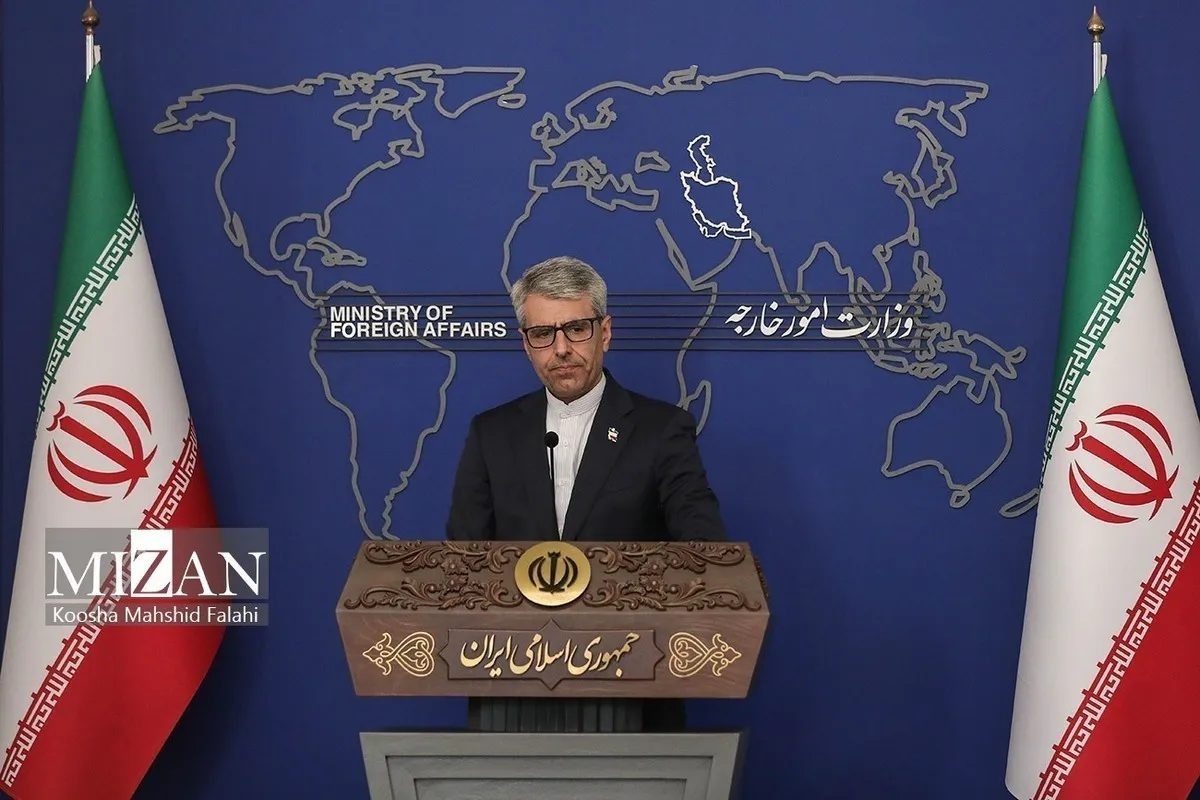
The weekly press conference of Foreign Ministry Spokesperson Esmail Baghaei was held on Monday, November 10, 2025, during which he answered questions from domestic and foreign media representatives about key issues in Iran’s foreign policy over recent days.
Regarding Donald Trump’s explicit admission of U.S. involvement in the Zionist regime’s attack on Iran and the issue of compensation from the United States as a precondition for talks, Baghaei stated:
“This is the latest evidence of America’s participation in aggression against Iran. We have never doubted Washington’s active complicity in this crime. Trump’s explicit admission of full responsibility for the aggression—contradicting the U.S. Secretary of State’s denial on June 12—is a clear confession to an international crime and establishes the full legal responsibility of the U.S. government.”
He added that Iran has submitted this admission to the United Nations and the UN Security Council as part of its documentation process regarding the Israeli and American acts of aggression:
“This confession will serve as an official document in any legal proceedings. The process of documentation continues in coordination with the Judiciary and the Legal Affairs Department of the Presidency.”
Addressing IAEA Director General Rafael Grossi’s recent comments on Iran’s nuclear capability, Baghaei said: “The Director General himself has repeatedly stated, including in his latest interview, that Iran’s nuclear program is peaceful and there is no evidence of deviation.”
He emphasized that Iran expects the IAEA to refrain from making statements beyond its technical and legal mandate, adding: “As long as we remain a member of the NPT and committed to the Safeguards Agreement, we recognize our obligations. Last week, IAEA inspectors visited several nuclear sites, including the Tehran Research Reactor. According to parliament’s resolution, all further inspections must be conducted under the supervision of the Supreme National Security Council.”
Baghaei warned that the IAEA must understand the post-attack situation has changed: “We maintained normal cooperation with the Agency and even established the Cairo Understanding after the Zionist regime’s assault. The party to be blamed here is the European troika (Britain, France, Germany), who disrupted the process by triggering the so-called ‘reverse trigger mechanism.’”
On the Israeli claim that Iran attempted to assassinate its ambassador in Mexico, Baghaei dismissed it as “ridiculous and baseless”:
“It was so absurd that it didn’t even warrant an official response. Similar fabrications—such as the one involving Australia that led to the downgrading of relations—follow the same pattern. Australian police confirmed that there was no link to Iran in the so-called anti-Semitic incidents. The Zionist regime chose Mexico because public opinion there strongly condemns the genocide in Gaza.”
He added that while Iran’s relations with Australia have been reduced, consular operations at Iran’s embassy in Canberra remain active, and Australia’s consular activities in Tehran continue with the cooperation of friendly nations.
In response to a question about Iran’s annual human rights reports on the U.K. and the U.S., Baghaei said:
“The Foreign Ministry is obligated to issue yearly reports on human rights violations in these countries because they claim global leadership in human rights while using it as a political weapon to pressure and threaten independent states.”
He continued: “Exposing the hypocrisy of their so-called human rights advocacy is an international responsibility. The instrumentalization of human rights has become widespread, and these reports serve to inform both domestic and global audiences. They are also credible references for use at the United Nations and other human rights bodies.”
On Iran-U.S. relations, Baghaei remarked: “Iran’s perspective toward the United States is not based on temporary tensions but on long historical experience. We look forward but do not forget the past. Some suggest Iran should take unilateral ‘bold steps’ while ignoring America’s aggression and regional conduct—this is incorrect. The U.S. attacked Iran, boasts about it, and then claims readiness for negotiations.”
He added: “Iran was targeted in the middle of a negotiation process. Trump’s remarks about a ‘22-year rehearsal’ for attacking Iran reveal the reality. When the U.S. shows no commitment to a reasonable, law-based negotiating process, entering talks becomes extremely difficult.”
Commenting on talks with the U.S. and Europe, Baghaei said: “They acted deceitfully, lacked goodwill, and showed no seriousness in negotiations. Nonetheless, our diplomatic engagement is not limited to nuclear issues. The Europeans’ misuse of the ‘snapback mechanism’ was a grave mistake and affected the talks. Despite this, diplomatic exchanges continue, embassies remain active, and while Europeans express interest in dialogue, their actions show no sincerity. Deeds, not words, matter.”
On U.S. pressure regarding Iraqi political groups, he said: “Iraq’s elections are of great importance. Any foreign interference in this process is unacceptable to the people and government of Iraq as well as to regional countries. U.S. meddling has been harmful, consistently leading to insecurity and instability.”
Baghaei stressed that Iraq’s security and stability are vital for Iran, adding: “Our neighbor knows how to manage its relations with other actors. Our ties with Iraq are friendly, and regardless of the election outcome, our relations will continue. Iraq’s elections are an internal matter, and we hope its people will play their full role in shaping their country’s political future.”
Regarding Richard John, an Iranian Armenian national imprisoned in the U.K., Baghaei said:
“Members of Iran’s Armenian community in parliament have sent an open letter to British officials demanding his release. He has been imprisoned for about 20 years. According to the Parole Commission’s own decision, he should have been released between 2011 and 2012, but British authorities have refused under various pretexts.”
Baghaei added: “He is in poor health, and we demand his release so he can continue treatment in Iran and reunite with his elderly mother. Britain’s claim that his release would endanger public safety is unfounded. He is not a dual national—he renounced his British citizenship. We defend the rights of our citizens regardless of religion or political belief.”