Recovering of Hadar Goldin’s body: Gaza unveils Israel’s hidden failure after 11 years
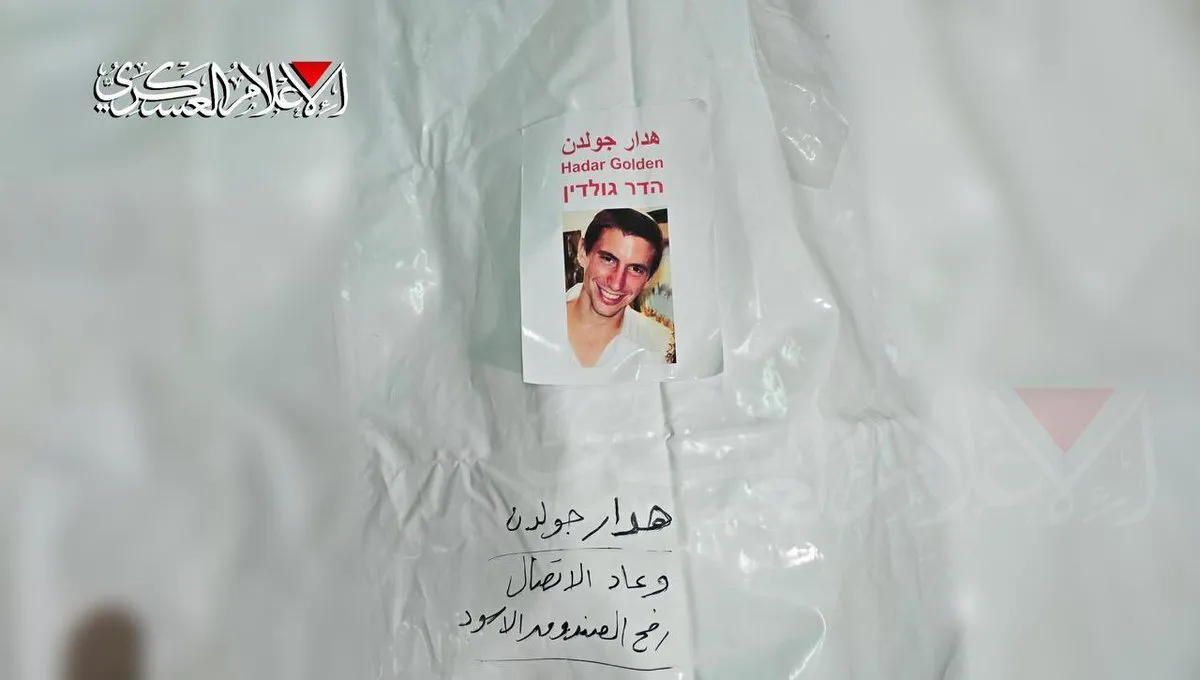
Yesterday afternoon (November 8, 2025), the Izz al-Din al-Qassam Brigades, the military wing of Hamas, announced that they had successfully retrieved the body of Israeli officer Hadar Simcha Goldin from the tunnels in Rafah, southern Gaza.
Once again, Goldin’s name topped Hebrew media headlines, despite the Israeli army having had no knowledge of his whereabouts for exactly 4,117 days.
The Goldin case has, over the past 11 years, remained one of Israel’s most sensitive internal issues, driven by political and media pressure from his family demanding his return.
Who is Hadar Goldin?
Hadar Goldin was born in 1991 in the town of Eshkar in Lower Galilee, northern occupied Palestine, where he also grew up. He completed his secondary education at Kfar Batya School in Ra’anana before joining the “Bnei David” religious-military institute in Eli, a center for training religious officers for the Israeli army. Upon graduation, he immediately entered the military.

Goldin joined the reconnaissance unit of the Givati Brigade — one of Israel’s elite field units — and quickly advanced through missions, eventually achieving officer rank. According to the occupation army, he demonstrated exceptional performance.
On August 1, 2014, during the Gaza battles, Goldin participated in a field mission in Rafah aimed at identifying tunnel networks. Minutes before a ceasefire was set to take effect, a severe clash erupted between Hamas forces and the Israeli unit, resulting in Goldin’s capture at the age of 23, alongside several other soldiers being killed or wounded.
On the same day, Israel activated the “Hannibal Protocol” for the first time in southern Gaza — a directive allowing the use of unrestricted heavy fire to prevent the capture of an Israeli soldier, even if it results in his death.
Israel initially announced Goldin’s death, but Hamas provided no information on his fate, fueling over a decade of speculation and debate.
11 years of search: Israel’s intelligence failure
Over the past 11 years, Israel conducted extensive military and intelligence operations to locate Goldin, dead or alive, but all attempts failed. Official Israeli media reported that his body was discovered in an area under Israeli control, where the army had conducted daily operations last year in the same Rafah tunnel, yet had found no trace of Goldin.
The Goldin case became a tool of domestic pressure against successive Israeli governments, with his family repeatedly accusing political leaders of incompetence in securing his return.
Now, after 4,117 days, the al-Qassam Brigades revealed the retrieval of Goldin’s body. Israel’s Channel 12 reported moments ago that the Red Cross has received the body from the Palestinian resistance in southern Gaza.
This development has sparked renewed questions regarding the responsibility of the occupation government and its intelligence failures.

Hadar Goldin was more than a soldier; he became a symbol of Israel’s intelligence and military failure. Despite extensive operations and repeated incursions into Gaza, Israel could not ascertain his fate. His familial connection to former War Minister Moshe Ya’alon also heightened the case’s sensitivity within Israel.
The announcement of Goldin’s retrieval is seen as a symbolic blow to Israel, reopening the wounds of the army’s failures and demonstrating that the resistance was able to maintain leverage over the course of a decade, despite blockades and repeated attacks.
Unanswered questions about the Goldin mystery
The al-Qassam Brigades stated yesterday that alongside Goldin’s body, they also retrieved the bodies of six of their martyrs from the same site. This has led some social media users to speculate that the location was not merely Goldin’s burial site but possibly an active field position protecting a highly important target.
Others suggested that the retrieval alongside six resistance fighters indicates they were tasked with protecting him and that Goldin may have been alive until the recent conflict, rather than dying 11 years ago.
Some users emphasized that the released images of the martyrs could not belong to a group merely guarding a body, reinforcing the possibility that Goldin remained alive until recently.
A psychological blow to Israel
Media activists argue that the timing and manner of the announcement by al-Qassam carry deep political and symbolic messages. Given al-Qassam’s strict discipline in managing prisoner cases, the release of such information is unlikely accidental.
Social media users claim that the announcement of Goldin’s body was directly aimed at Israeli Prime Minister Benjamin Netanyahu, shaming him before Goldin’s family, who have long demanded clarity on their son’s fate, and exposing the Israeli military’s incompetence, which declared him dead shortly after his capture.
Analysts, as reported by the Palestinian Shihab News Agency, suggest that the events in Rafah shattered Israel’s narrative of “complete control” over prisoner locations last week — a narrative claiming the army knew the exact site and that its inaction was deliberate.
The reality on the ground revealed that the so-called all-knowing enemy was unaware of what lay beneath its feet, while the resistance demonstrated that true knowledge lies not in satellites or aerial surveillance but in dedication to truth and precision in action.