Baghaei: UN Security Council Resolution 2231 has expired
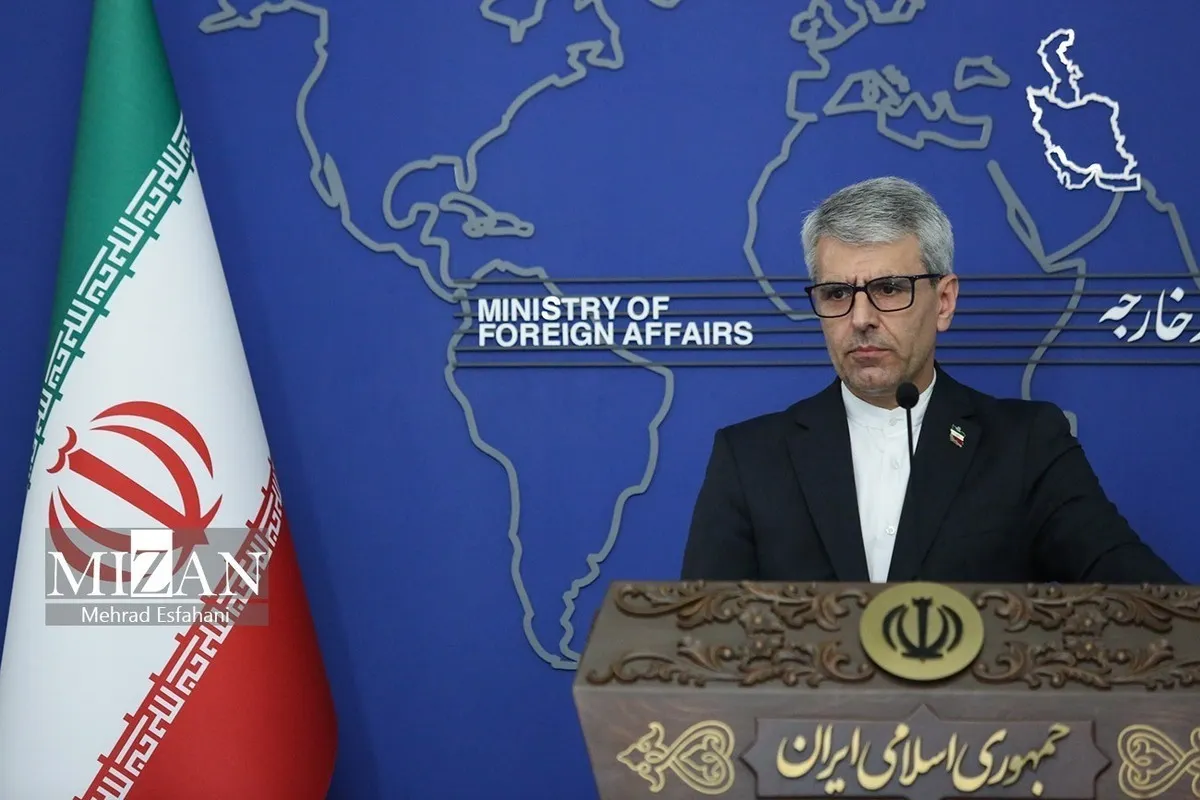
Speaking at his weekly press conference on Monday, October 20, 2025, Baghaei addressed questions from domestic and foreign media about key developments in Iran’s foreign policy, calling the situation in Palestine the most critical issue in the region.
He said that despite the ceasefire agreement, over 80 violations had been committed by the Zionist regime, while the Rafah crossing remained closed contrary to earlier promises, and aid deliveries of 600 trucks per day never took place.
“Once again, the Zionist regime has failed to honor its commitments, and the United States—despite acting as the guarantor of the ceasefire—has not fulfilled its obligations,” he said.
Baghaei stressed that Iran’s position on Gaza has been clear from the start of the genocide: “We have consistently emphasized the need to pressure the Zionist regime to halt the killings, lift the blockade of Gaza, withdraw occupying forces, and begin reconstruction. Our concerns are based on experience; Israel has never honored its promises, and this is now clearly evident.”
He added that after Hamas fulfilled its obligations, the Zionist regime began evading its own commitments. Regarding the Gaza Reconstruction Conference, Baghaei said Iran had not yet reached a decision but reiterated Tehran’s commitment to supporting the Palestinian people, as stated in its October 5 declaration.
Baghaei also expressed concern about clashes between Afghanistan and Pakistan, noting that Iran had called for restraint from both sides and welcomed the recent ceasefire as a step toward dialogue.
On the issue of unilateralism, the spokesman said that recent developments were the result of a year-long diplomatic campaign anticipating European misuse of international mechanisms. He highlighted the Cairo Understanding as one of Iran’s key diplomatic achievements.
“The E3, following the U.S. lead, tried to reactivate terminated sanctions resolutions. The opposition of two permanent members of the Security Council (Russia and China) to this move means that the Council has failed to reinstate the lifted sanctions—this is a precise legal fact,” he said.
Baghaei continued: “China and Russia clearly stated that the Europeans, as violators of the JCPOA, have no right to invoke the snapback mechanism. Their continued position on this matter is significant. Therefore, we consider Resolution 2231 terminated as of October 17, and the UN Secretariat must act accordingly.”
He reaffirmed that the majority of the international community opposes the U.S. and E3’s attempts to abuse international institutions.
“In our official statement, we announced the end of Resolution 2231. According to its explicit text, it expired on the date of termination. Certain rights obtained under it—such as Iran’s right to enrichment—remain unchanged. The JCPOA was a temporary understanding meant to lift illegal, nuclear-related sanctions in exchange for Iran’s transparency measures. The E3 and the U.S. violated it. The expiration of Resolution 2231 does not alter Iran’s core commitments, including its pledge not to pursue nuclear weapons.”
Regarding Iran’s relations with the European troika, Baghaei stated that the E3 must now prove their capacity and will to engage as negotiating partners, something Iran has not observed.
“Even the German Chancellor recently admitted the EU’s inability to influence regional developments due to its lack of military leverage—this is concerning,” he said.
On the activation of the snapback mechanism, Baghaei said: “This is not the first time the U.S. has abused the UN Security Council. In 2020, Washington attempted to use it to reinstate sanctions. In recent weeks, the E3, without legal standing, tried to justify the return of terminated resolutions. The reality is that the Security Council has made no decision to reinstate them. Many countries support Iran’s position; misuse of a process cannot create legal consequences.”
He also addressed the issue of non-EU states following U.S.-EU sanctions, noting that these states, as EU membership candidates, have obligations but must still fulfill their independent UN commitments.
Baghaei emphasized that Iran’s nuclear issue is not an international dispute, calling it a pretext fabricated by the Zionist regime and imposed on the UN system.
“The nuclear issue must be handled within the framework of Iran’s rights under the NPT. Any future diplomatic process will begin only when the other sides are ready for reasonable dialogue based on Iran’s interests.”
Regarding Iran’s non-participation in the Sharm el-Sheikh conference, he explained that the decision followed internal reviews by relevant institutions and concluded that Iran would not take part.
On IAEA Director-General Rafael Grossi’s recent remarks, Baghaei said: “The IAEA plays an important technical role in nuclear affairs. As long as it acts within its mandate and avoids politicization, it will have our respect. The Agency must not allow itself to be exploited by Western states.”
He also referred to Russian Foreign Minister Sergei Lavrov’s comments about Iran-Russia cooperation, noting that relations between the two countries are expanding in all areas, supported by several key agreements, including a Comprehensive Strategic Treaty.
“Both Iran and Russia believe that Resolution 2231 has ended, and bilateral cooperation will continue,” he said.
Regarding Ali Larijani’s trip to Moscow, Baghaei confirmed that Tehran and Moscow regularly consult on security issues and that Russia’s special envoy for Syria was meeting Iranian officials the same day.
Finally, on Egypt’s mediation efforts between Iran and the U.S., Baghaei noted that indirect contacts with mediators continue, but this does not mean that negotiations have begun.
“As long as excessive demands persist, there will be no grounds for negotiation or understanding,” he said, adding that Gaza was among the key topics in talks with the Egyptian foreign minister.
“Although indirect contacts have continued in recent days, we cannot say we are on the verge of a new diplomatic process,” he concluded.