Baghaei: Iran supports the halt of genocide in Gaza
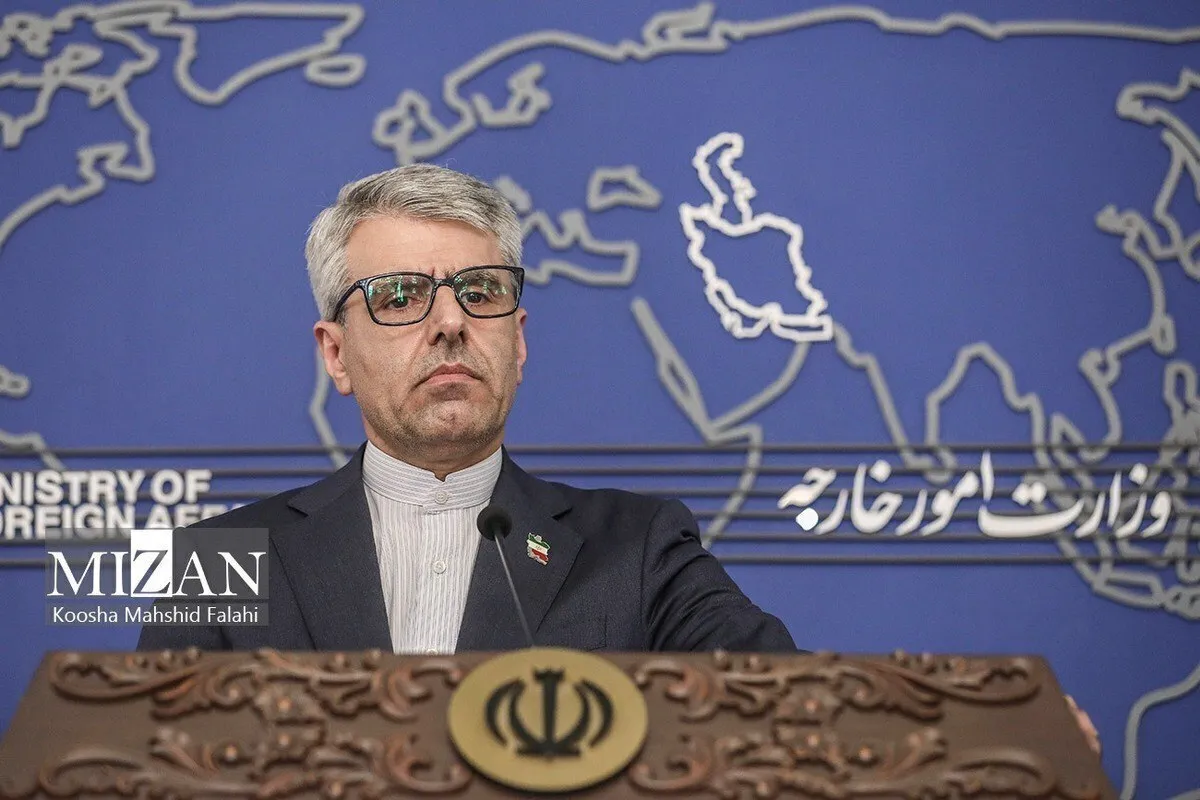
Ismail Baghaei, the Foreign Ministry spokesperson, on Monday, in his weekly press briefing responded to questions from domestic and foreign media about the most important developments in foreign policy in recent days.
At the beginning of the press conference, Baghaei referred to rapid developments in the region and international arena and said: the developments in West Asia and our surrounding region require timely reactions and decision-making; still, the most important regional issue is Gaza and the occupied Palestine; after more than 700 days of genocide in Gaza, an agreement was reached for the Zionist regime to stop its attacks, and we have clearly declared our position in this regard.
He added: the cessation of bombing Gaza revealed the scale and depth of the crimes; debris clearance is underway in this region; based on our region’s experience over the past decades and the repeated violations of ceasefires in Lebanon by the Zionist regime, the international community and regional countries must watch with open eyes so that the Zionist regime does not break its commitments out of longstanding habit.
Baghaei said: we carefully assess every development and every action and reaction in our surrounding environment and at the international level, and evaluate the opportunities and threats arising from regional trends and changes.
He stated: we have always had all aspects of ending the Gaza war under review; Iran is in a position to confront threats appropriately and to evaluate threats in various challenges.
In another part, regarding the so-called peace plan of Donald Trump, he said: Iran’s position was explained in two clear statements on October 6 and last Thursday; we have always supported any action that would lead to the halt of genocide in Gaza.
He added: our main demand over the past two years has been to end the genocide and blockade of Gaza and to withdraw the occupiers from this region; in bilateral and multilateral interactions, we have always asked for these.
The spokesperson of the diplomatic body said: the assault on ethics and humanity occurred alongside the violation of international law in the Gaza war; António Guterres, the Secretary-General, earlier said that October 7 did not happen in a vacuum; as long as the right of Palestinians to self-determination is not realized, we cannot hope for solving this issue.
Baghaei, about Iran’s participation in the Sharm el-Sheikh meeting, said: we received an invitation from Abdel Fattah el-Sisi, President of Egypt, addressed to our President.
He added: all aspects were reviewed in expert sessions inside and outside the Foreign Ministry, and positive and negative dimensions of participating or not participating were weighed, and ultimately the decision was reached that best served the country’s interests, which was announced.
The spokesperson of the Ministry of Foreign Affairs, stating that playing a role in regional and international developments is not necessarily shaped by physical participation in an event, insisted: Iran’s influence and effectiveness is not limited to attending or not attending an international meeting; over the past two years, we have been among the primary actors exerting pressure on the Zionist regime; we have operated and will operate at the level of the Organization of Islamic Cooperation, the United Nations, and the region.
In response to a question from Mizan regarding the Foreign Ministry’s reaction to criticism from some Western media and institutions about the selection of representatives from Iran and China in the Consultative Committee of the UN Human Rights Council, he said: it is very strange that such sensationalism arises over the election of two countries’ representatives for membership in a consultative committee of the Human Rights Council.
He added: this shows the totalitarian mentality of countries that try to dominate international institutions; Iran is a member of the United Nations and an observer in the Human Rights Council, and has the right to nominate its representatives for any sections related to the Human Rights Council.
The spokesperson of the Foreign Ministry emphasized: the presence of Iran and other countries, including China, in this domain will be beneficial, because it brings a more balanced perspective to human rights issues and other international matters.
Baghaei, about comments by Vladimir Putin, President of Russia, regarding a message from the Zionist regime to Iran about no new attack, said: we listen to what friendly countries say and at the same time monitor developments, and we believe given the track record of deception by the Zionist regime it is necessary to always maintain vigilance at all levels, including in defense.
The Foreign Ministry spokesperson, in another part about the latest status of the case of Mahdieh Esfandiari, the Iranian citizen detained in France and prisoner exchange with that country, said: we are seriously pursuing the Esfandiari case and preparations on our side have been made.
Baghaei, in another part about possible negotiations with the United States, stating that no country or governance system can make decisions without considering prior experiences in interactions with other countries, said: the current decisions are the result of past experiences, and over the past decades, especially in recent months, we have had bitter experience with the U.S.
He added: in the future, too, with open eyes and considering the country’s interests and when the system reaches the conclusion that diplomacy will serve national interests, we will make decisions about negotiations.
Baghaei, about the recall of Iran’s ambassadors from three European countries, said: our ambassadors in the UK, Germany, and France were summoned for consultation and we held multiple sessions to examine dimensions of relations with the three European countries; they returned to their posts.
He, referring to the European Troika’s statement about readiness for negotiations, said: that statement is a repetition of the positions of the three European countries at different times; some provisions of the statement are irrelevant and, in some parts, there is no goodwill; Europeans must show that they have independence of action and decision-making ability to be recognized as credible actors before public opinion and the international community.
Baghaei, in reaction to some reports about the Zionist regime’s activities against Iran in cyberspace, said: what was clear to us was stated; it was clear to us that simultaneously with the Israeli regime’s aggression against Iran, a multilateral campaign and cognitive warfare was executed against Iran to impose distorted narratives.
He added: what our media and officials repeatedly warned about was confirmed by Western media with documents and evidence; this shows that the Zionist regime is carrying out a targeted campaign to destroy individuals and media so that a balanced narrative of regional developments is not presented; this cognitive war is being used against various countries in the region.
The spokesperson of the Ministry of Foreign Affairs, about Iran’s relationship with the International Atomic Energy Agency, said: we remain a member of the NPT and committed to the safeguard’s agreement; we have tried within the framework of an understanding with the Agency to establish conditions for interaction under new circumstances, but the opposite parties did not appreciate Iran’s good faith.
He added: European efforts to restore the rescinded resolutions of the Cairo understanding have undermined its effectiveness, and these three countries are responsible for these conditions; we can’t say that in the coming days we will have contact or consultation with the Agency, but diplomacy is not something that can be halted.
Baghaei, regarding the politicization of the Nobel Peace Prize and the selection of the 2025 laureate, said: these awards cannot be used as criteria to distinguish peacemaking or opposition to peace; the nominees of these awards also do not always have a clear record in advancing peace.
He emphasized: people throughout history have received this award and similar ones while having controversial positions and dark legacies regarding peace; putting these actions together, it wouldn’t be far-fetched if Netanyahu demands the Peace Prize next year.
Baghaei, in another part about reports of the deaths of two Omani citizens, said: it is not just about Iran’s water, and the quality of the water Iran exports is clear; the issue is the reputation of the Iranian company involved that was tarnished in this process.
He said: in contact with the Iranian embassy in Oman, we followed up the matter with Omani authorities; during the summons of Oman’s chargé d’affaires to the Foreign Ministry yesterday, we requested follow-up on the issue.
The spokesperson of the diplomatic body added: the Foreign Ministry’s economic diplomacy has taken necessary measures to support the commercial rights of Iranian companies abroad; we await the needed explanation from the Omani side.