Head of the Judiciary visits the Museum of the Islamic Revolution and Sacred Defense / Judiciary Chief: Aggressor Saddam obtained biological, chemical, and mass-killing weapons from the US, UK, France, and Germany
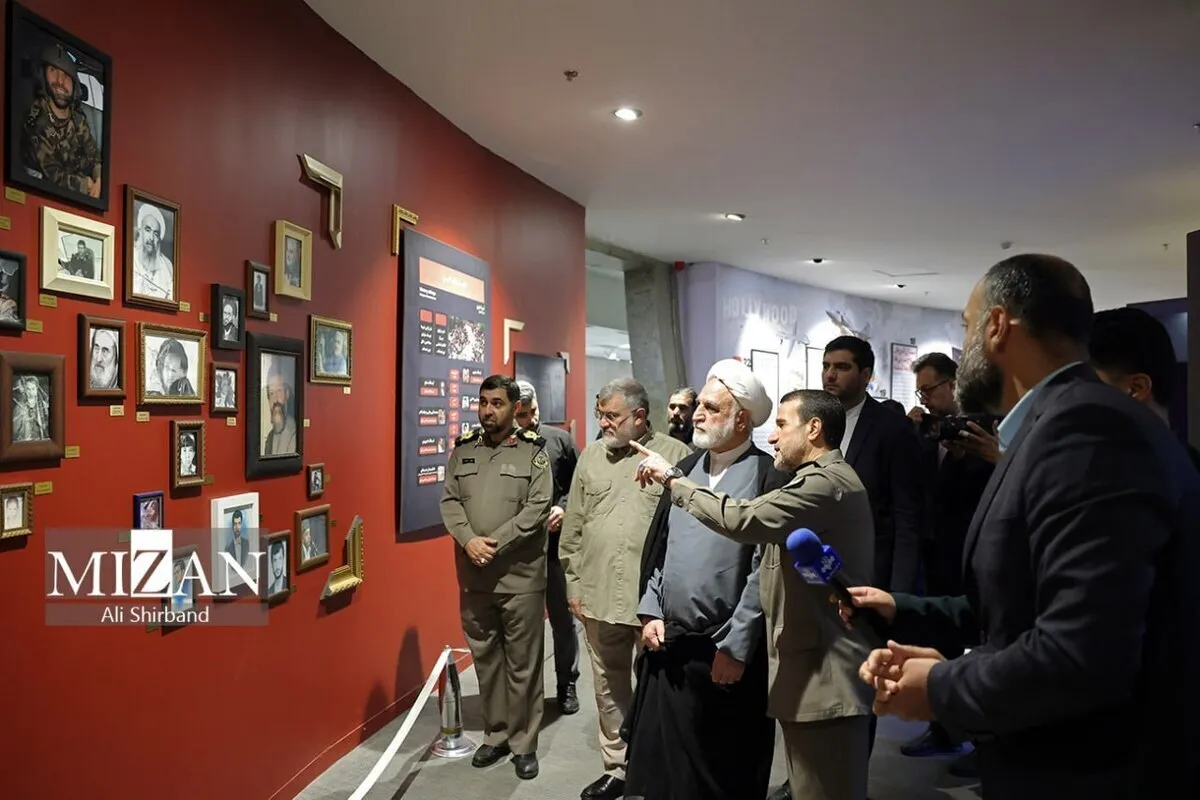
According to the Judiciary Media Center, Mohseni Ejei, during the sixth ceremony honoring veterans of jihad and resistance, commemorating Sacred Defense Week, said: “You veterans of the Sacred Defense are the narrators of the heroic deeds of that glorious era. You ensure that these feats and acts of bravery are not forgotten or distorted.”
The judiciary chief further explained the conditions of the country at the start of the eight-year imposed war: “During the eight-year war, Saddam, supported by global arrogance, invaded our country, while anti-revolutionary groups, under the false banner of ‘supporting the people,’ turned their weapons against our citizens. Despite claiming anti-imperialism, they received weapons from the Americans to assassinate the Iranian people.”
Referring to Saddam’s supporters during the war, Mohseni Ejei stated: “Aggressor Saddam obtained his biological, chemical, and mass-killing weapons from the US, UK, France, and Germany. These same regimes today stand against the Iranian nation and attempt to impose their malicious agendas on the Iranian people.”
Mohseni Ejei also drew parallels between the eight-year imposed war and the recent 12-day defense, saying: “During the eight-year war, the Iranian nation did not give an inch of its land to the enemy. Similarly, in the recent 12-day war, the nation defended its geographical and value-based borders with full power and resolve, punishing the enemy for its actions.”
The judiciary chief explained: “During the 12-day conflict, when the Zionist aggressors could not confront Iran’s armed forces, they turned to the Americans, who also received a firm response. Since World War II, no country attacked another and received such a strong reply; the Iranian armed forces achieved this and humbled the US and its Zionist ally.”
He highlighted the factors contributing to Iran’s victory in the 12-day defense: “Divine guidance and the wise leadership of the Supreme Leader, national unity around the principle of the Guardianship of the Islamic Jurist (Velayat-e Faqih), defense of the homeland, and the strength and determination of Iran’s armed forces were key elements in achieving success.”
Mohseni Ejei reiterated the enemy’s miscalculations during the recent imposed war: “The enemy believed it could achieve its goals with two operations: assassinate some officials and destroy key locations to coerce the people. This shows that even after forty-plus years, they still do not understand our nation or system. Enemy think tanks, despite their claims of material calculations, have failed to recognize the Iranian people, who are proud, dignified, and uncompromising in their honor.”
He added: “At the start of the imposed war, the enemy captured some of our top commanders, but with the Supreme Leader’s wisdom, new commanders quickly replaced them, and a comprehensive defense strategy was implemented, forcing the enemy to retreat and request a ceasefire.”
Mohseni Ejei emphasized: “In the 12-day war, all enemy plans failed. If national unity around the Supreme Leader and defense of the homeland is preserved and strengthened, all malicious plots will be neutralized.”
He further noted: “During the eight-year war, most of our commanders were young men, who later became skilled leaders, producing figures like Martyr Qasem Soleimani. Even today, if a war occurs, these young people, with even stronger faith than their predecessors, will defend Iran’s sovereignty, honor, and national dignity.”
Mohseni Ejei commented on the enemy’s current state: “Today, the enemy is more resentful than ever, having been defeated in all arenas and failing to achieve any of its objectives regarding our country and system. Those who fully supported Saddam during the eight-year war are now supporting Zionists, and the same propaganda outlets that attacked Iran during the previous war are again spreading disinformation and aggression against our nation and system.”
He stressed the importance of explaining the Sacred Defense: “We must not allow the values and achievements of Iran’s Sacred Defense in the eight-year and 12-day wars to be forgotten or distorted. Explaining these events is essential to preserving our national and religious identity.”
During the ceremony, 20 new books on the Sacred Defense were unveiled. Veterans, active narrators of the Sacred Defense, and families of Iran’s martyrs were honored. Mohseni Ejei was also presented with a Sacred Defense narration uniform and ID.
Prior to the ceremony, Mohseni Ejei visited the Museum of the Islamic Revolution and Sacred Defense for two hours, touring areas including the General Soleimani Resistance Hall, the Sacred Defense Encyclopedia Center, and the “In Military Uniform” exhibition.
He emphasized the importance of educating the new generation about the sacrifices of the eight-year Sacred Defense, stating that even those who experienced the war may not fully grasp the extensive information, statistics, and documents housed in the museum.
He highlighted the “popular nature” of the eight-year Sacred Defense: “People responded to the call of the Imam with unity and cohesion, defending Islam and the homeland. Iranian youth courageously faced the enemy without fear, demonstrating faith, honor, and selflessness.”
Mohseni Ejei concluded: “To truly understand the eight-year Sacred Defense, one must recognize the circumstances of the time: a newly established Islamic Republic facing a foreign military invasion and internal threats from hypocrites. Our brave citizens, with faith and national pride, defended the country and defeated an enemy backed by Eastern and Western powers.”
He further remarked that the 12-day defense showcased the same heroism as the eight-year Sacred Defense: “During the 12-day conflict, Iranian forces demonstrated unparalleled bravery and resolve against American-backed Zionist aggression. The Zionist regime, which had previously resisted multiple countries simultaneously, suffered significant blows and was forced to propose a ceasefire.”