Explaining the dimensions of the recent attack on Iran / Silence of the Security Council opens the way for global insecurity / Attack on Iran’s peaceful nuclear facilities is a clear violation of the UN charter
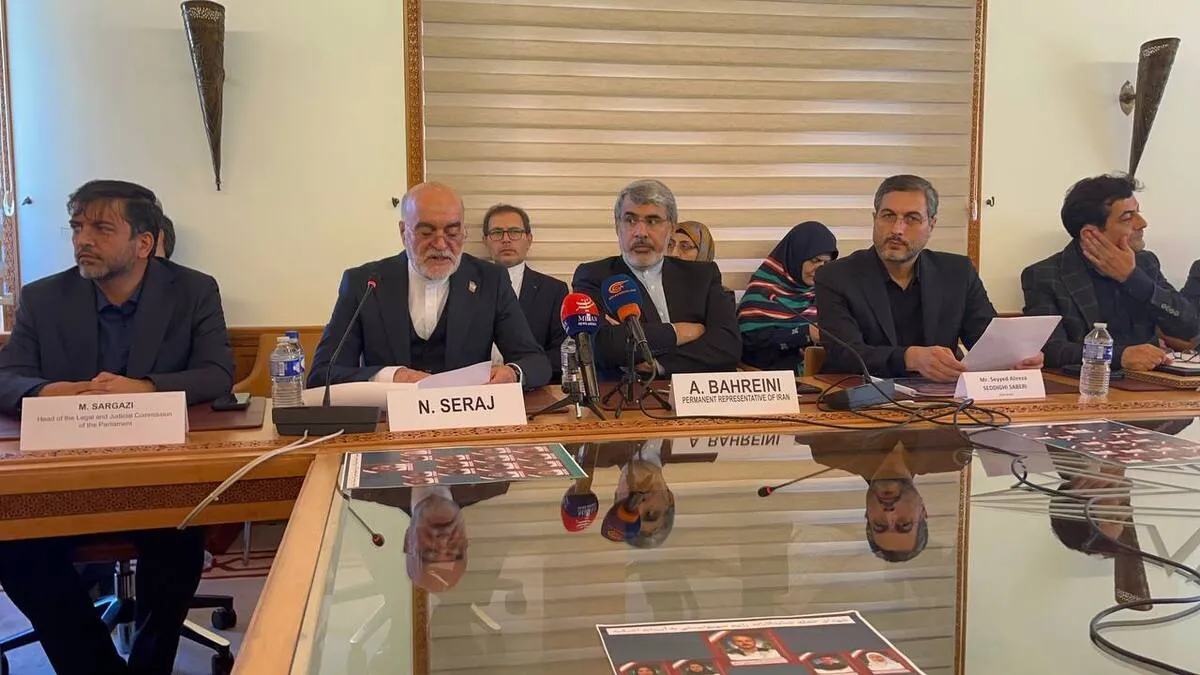
Naser Seraj, Deputy for International Affairs of Iran’s Judiciary and Secretary of the High Council for Human Rights, during his speech at the session, detailed the recent aggression by the Israeli regime against Iran and its consequences, while expressing deep concern about systematic human rights violations of Iranian citizens by some Western countries.
Expressing his appreciation for the opportunity to hold this session through Iran’s Permanent Mission in Geneva, Seraj thanked the rapporteurs and guests present and stated: “My motivation for being here with you is the serious and increasing concern over the gross violations of the rights of my fellow citizens by certain Western countries in various forms.”
Referring to the Israeli attack on Iran in the early hours of June 13, 2025, he said: “While the Islamic Republic of Iran was engaged in nuclear negotiations in good faith, it became the target of a blatant attack by the occupying Israeli regime. Even more regrettably, the United States not only shirked its responsibilities to maintain peace and security but, in full support of the aggressor Israeli regime, targeted four of Iran’s peaceful nuclear facilities under IAEA safeguards.”
Seraj added: “These unlawful actions, in violation of international law, occurred while the U.S. had already unilaterally withdrawn from the JCPOA in May 2018 and imposed the broadest illegal and arbitrary unilateral coercive measures with the unlawful goal of ‘regime change’ in Iran—sanctions that directly targeted the daily lives of ordinary people, public order, and security, causing irreparable consequences.”
Highlighting the expansion of Israeli crimes in the region, Seraj said: “You are all well aware of the shocking crimes currently taking place in Gaza, with tens of thousands killed, including women and children, deliberately placed at risk of annihilation. Meanwhile, the people of Lebanon are under bombardment, Syria faces continuous aggression, and the recent attack on Qatar demonstrates the regime’s brutal expansionist tendencies. Sadly, the security and right to life of the people have become a tool for the Israeli regime’s illegal expansionist policies in our region—a regime shielded from accountability for actions that are not only illegal but extremely inhumane, beyond description, and distressing to every conscious conscience.”
Criticizing the silence of international institutions, Seraj stated: “The people of Iran expected urgent and immediate action from international peace and security bodies, including the Security Council, to stop these flagrant violations of international law. Yet, political maneuvering, inaction, and unacceptable silence by these institutions have resulted in nothing but growing despair among people for justice and the spread of insecurity, war, and deprivation.”
He continued: “The onset of the Israeli aggression coincided with the 59th Human Rights Council session. We had a serious expectation that these attacks would be condemned specifically by the Council and human rights institutions. We expected decisive action from Council members against the Israeli and U.S. crimes, and this rightful expectation remains. Today, some family members of the victims are present to testify about these atrocities.”
Describing the human catastrophe resulting from the Israeli attack, Seraj said: “I will only highlight a portion of these crimes. In this 12-day imposed war, we witnessed systematic violations of international human rights and humanitarian law on a large scale. The Israeli regime deliberately committed breaches of peremptory norms, including arbitrary deprivation of life. Approximately 1,100 of our compatriots were killed, including 102 women—two of them pregnant—45 children, and 14 scientific and academic elites. Over 5,600 civilians were injured, and irreparable psychological damage was inflicted on our people.”
Emphasizing that the Israeli regime targeted civilians with the intent to destabilize Iran, Seraj said: “We call on the Human Rights Council to take effective measures against such violations and international crimes. The world has witnessed that this regime even targeted Evin Prison, killing at least 80 civilians; the Qods Square in Tehran, where 17 citizens, including a three-year-old child and a pregnant woman, were killed; and the pursuit and murder of a single family in two different locations across the country.”
He stressed: “These cases constitute concrete examples of war crimes and crimes against humanity. Fourteen members of a single family were killed in a targeted attack, with only one survivor, Mr. Sedighi Saber, present here to speak about this horrific tragedy.”
Seraj further explained: “The Israeli occupying regime spared no crime against my people. Critical civilian infrastructure, residential areas, hospitals, health and care centers, schools, kindergartens, emergency services, water and electricity systems, public spaces, roads, industrial facilities, commercial centers, and other civilian infrastructure were widely targeted, in blatant violation of general principles of international humanitarian law. These actions constitute not only war crimes but also clear crimes against humanity.”
He added: “Over 10,000 residential units, 210 commercial and industrial centers, 17 energy facilities, 16 educational centers, and 11 public passages were destroyed or severely damaged. The attack on Iran’s peaceful nuclear facilities also violated UN Security Council resolutions, including Resolution 533, and the UN Charter, posing a potentially catastrophic risk to public health and the regional environment—risks that the aggressors did not care about.”
Addressing the international community, Seraj said: “We believe these attacks and crimes should serve as a serious warning to the world, showing how power politics and unilateralism can violate global peace and security. Silence in the face of such unlawful actions opens the door to further insecurity, threatening the entire international community. Today’s global realities confirm this bitter truth. Our concerns regarding the aggressive, occupying, and apartheid policies of the Israeli regime are serious.”
He continued: “We expect the Human Rights Council to take effective action to stop and prevent Israeli crimes and to use all available means to compensate the material and moral damages to the Iranian people caused by the aggressors—the Israeli regime and the United States. We appreciate and acknowledge the special rapporteurs who explicitly condemned these aggressive acts and supported the rights of the Iranian people.”
Seraj addressed the UN rapporteurs: “We urge you not to limit yourselves to condemnation but to use all your available capacities to hold the criminal regimes of Israel and the United States accountable for the blatant violation of fundamental rights of the Iranian people. This is a serious and rightful demand of the victims and their families. We also call on institutions monitoring international human rights treaties to seriously address the violations and international crimes committed by Israel and the U.S. against Iran, to hold them accountable, and to take substantial steps in this regard.”
He also called on civil society: “As an independent monitoring pillar, you must pay closer attention than ever to the crimes of Israel and the United States and steer international human rights bodies toward their core responsibilities.”
Seraj emphasized: “Today, support for occupied Palestine, especially the people of Gaza, is a demand of people around the world. These demands must be heard responsibly, and effective steps must be taken. The movement to save the people of Gaza, through the ‘Global Sumud Fleet,’ should be recognized by UN organs responsible for peace and security.”
In conclusion, he said: “I thank you for your attention. I call on awakened and justice-seeking consciences to amplify the voices of the Iranian people and the families of victims to the international community.”