Head of Judiciary: Today, in the field of international law and in defending the oppressed, we must move beyond a defensive stance and adopt an offensive approach
According to the Judiciary’s Media Center, in his 44th provincial trip since assuming office, Mohseni Ejei entered Golestan Province today (Tuesday, September 9) in an unannounced and unofficial visit with the high-ranking judicial delegation.
During this trip, the Chief Justice and other senior judicial officials have arranged programs aimed at addressing the legal and judicial issues of the people of this province.
Meetings with judges, various social groups, and elites, as well as following up on the implementation of resolutions from the previous visit of the high-ranking judicial delegation to Golestan, are among the key programs of this visit.
It is worth noting that since taking office on July 1, 2021, Mohseni Ejei has officially traveled to the provinces of Ilam, Qazvin, Khuzestan, Golestan, Razavi Khorasan, Sistan and Baluchestan, Qom, Yazd, South Khorasan, Zanjan, Markazi, Isfahan, Alborz, Kurdistan, East Azerbaijan, Kerman, Ardabil, Bushehr, Hormozgan, Kohgiluyeh and Boyer-Ahmad, Chaharmahal and Bakhtiari, Semnan, Tehran, Kermanshah, Gilan, Lorestan, West Azerbaijan, Hamedan, and Mazandaran.
In addition to official provincial trips with the high-ranking delegation, the Head of the Judiciary has also included unofficial and unceremonious visits in his schedule. Provinces such as Alborz, Isfahan, Hormozgan, Bushehr, Kerman, Razavi Khorasan (twice), North Khorasan (twice), Mazandaran, Fars, Golestan, and Khuzestan have recently been destinations for such visits aimed at examining judicial matters.
According to the Judiciary Media Center, Mohseni Ejei, during his trip to Golestan Province and on the night of the blessed birth of the Prophet Muhammad (PBUH) and Imam Ja’far al-Sadiq (AS), attended the fourth international event of the Unity Week hosted by the Center for Lawyers, Official Experts, and Family Advisors of the Judiciary.
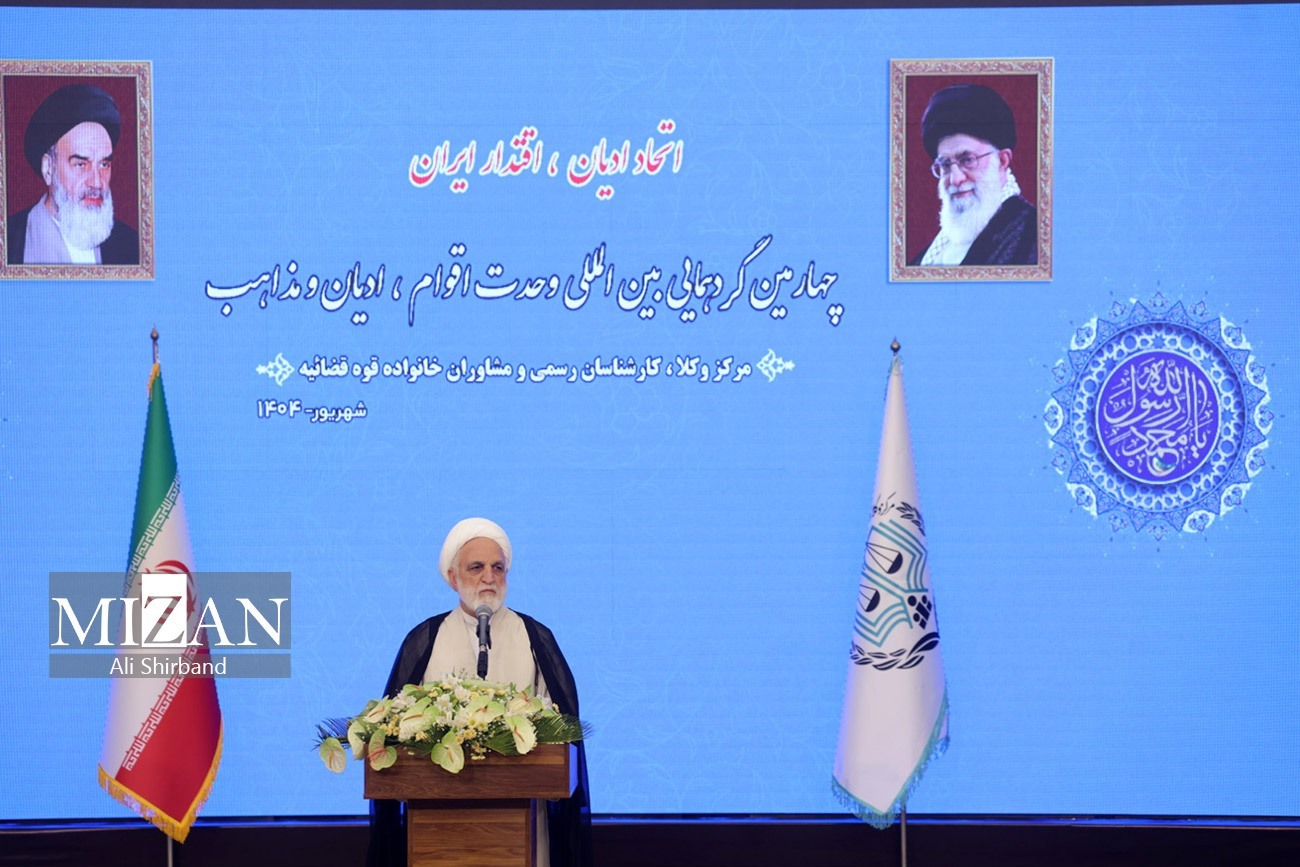
In his speech at the event, he stated: “Certainly, if Muslims had fully and comprehensively followed the teachings and guidance of the Prophet Muhammad (PBUH), we would not be witnessing today the horrific crimes of the Zionist regime in Gaza and other Islamic lands.”
The head of the judiciary added: “Even today, everyone has seen that the ruthless Zionist regime targeted Palestinian positions in Doha, once again proving that it recognizes no red lines or boundaries in its criminality and aggression.”
The Chief Justice said: “Today, in an era marked by the tyranny and madness of Zionist killers and their American and Western supporters, a heavy responsibility rests on our shoulders as legal professionals. We must deepen our knowledge and understanding of international law, not only to defend the rights of our own nation, which was violated during the 12-day war, but also to defend the rights of all oppressed people around the world, whether Muslim or non-Muslim, against the savage Zionists and their supporters.”
Mohseni Ejei emphasized: “You, as legal professionals, must assertively engage in the arenas of confronting global oppressors—especially Zionists and Americans—using your pens, words, and legal reasoning, and defend the interests of the oppressed.”
The head of the judiciary continued: “In the field of international law and in providing solid, reasoned legal defense for the oppressed worldwide against tyrants, we must move beyond a defensive posture and adopt an offensive and proactive approach.”
He stated: “Our goal is the expansion of justice and confrontation of oppressors. To achieve this goal, justice must be internalized and established within ourselves. Without embodying divine ethics and being characterized by justice, we cannot realize justice or stand against oppressors.”
According to the Judiciary’s Media Center, Mohseni Ejei, during a trip to Golestan Province, met in a cordial atmosphere with Shi’a and Sunni clerics as well as representatives of various social groups from the province.
In his remarks at the gathering, the head of the judiciary congratulated the birth anniversaries of the Prophet Muhammad (PBUH) and Imam Ja‘far al-Sadiq (AS), emphasizing: “Unity in both religious and national dimensions is an undeniable necessity and a central emphasis of great religious leaders. We must all safeguard religious and national cohesion, and thankfully, Golestan Province has been at the forefront in this regard.”
Addressing the demands of the people and elites of Golestan, Mohseni Ejei stated: “Today, boosting production and strengthening the country’s economic foundations are among the most essential issues. To resolve economic challenges, and even to repel the enemies’ schemes, we need to attract investment for production — and such investment depends on ensuring investor security. The judiciary is fully committed to this matter.”
Meeting with the judiciary’s staff in Golestan, Mohseni Ejei added: “The Holy Prophet of Islam was a mercy for all humanity, enduring immense hardships to fulfill his mission and guide mankind. Today, we seek to take this great Prophet as our role model.”
The judiciary chief continued: “In the fifth decade of the Revolution, we must work in such a way that Islamic values are elevated even beyond past decades. We, as officials and judiciary staff, must use our legal authority in the best possible way to serve Islam, the Revolution, and the people. If we fail to make the most of this opportunity, we will indeed be among the losers.”
Mohseni Ejei further stressed: “Today, the enemy is making great efforts to create division among the people, officials, institutions, and even among Islamic nations. The enemy seeks to keep Islamic countries weak, divide them, or place them in confrontation with one another.”
He added: “In such circumstances, creating discord and division in society is not only illegitimate but absolutely forbidden. On the other hand, striving for cooperation and unity is obligatory, necessary, and commendable.”
Speaking on internal ethics within the judiciary, Mohseni Ejei remarked: “When I personally hear of a colleague’s slip or misconduct, I endure great psychological pressure. Today, beyond the protection and disciplinary prosecution offices, each of us is responsible for safeguarding ourselves and our colleagues. If someone slips, they must first try to rectify it themselves. If others notice a colleague’s error, they should guide and advise them as much as possible. And if the protection office identifies such an issue, it should kindly remind the individual, rather than immediately taking punitive action.”
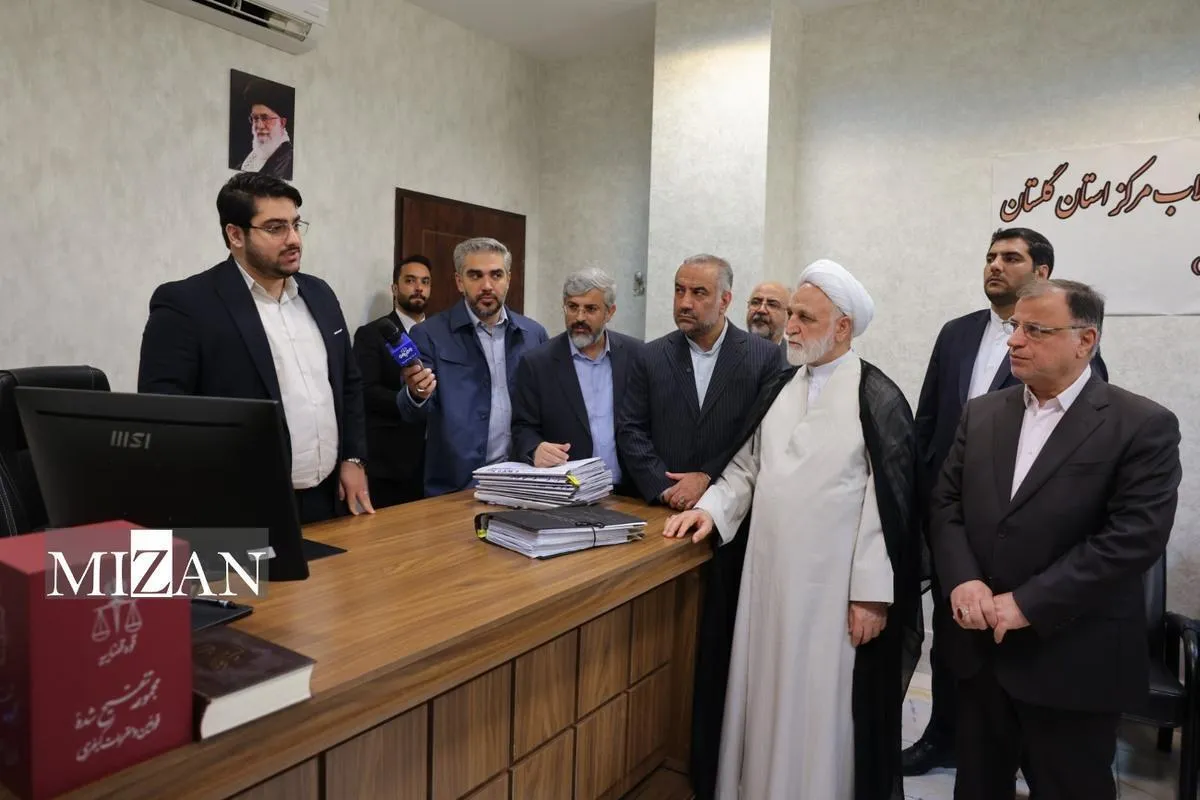
As part of his field inspections and problem-focused evaluations in Golestan Province, Mohseni Ejei visited the provincial prosecutor’s office, personally reviewing the process of handling cases.
During his inspection, he attended several branches of the prosecutor’s office, held close discussions with judicial officials, and personally reviewed a number of cases, offering professional recommendations to expedite the proceedings.
At the 8th Investigation Branch, he examined a case involving network fraud, unlawful acquisition of property, and abuse of influence through private connections with government officials. In this case, the defendants had taken money, property deeds, and assets from complainants by promising large loans, while also obtaining gold coins by claiming influence and promising to resolve their legal problems.
While studying the case, the Chief Justice directly questioned the defendants. One of them, accused of forgery and falsely claiming influence in government bodies, initially insisted on his honesty. However, through Mohseni Ejei’s sharp questioning, his lies were exposed.
Addressing the defendant, the Chief Justice said: “I am not here to verify the accuracy of your statements at this moment, but I emphasize to you and all defendants: in court, you must be absolutely truthful so that the legal grounds for leniency can be considered.”
Later, at the 2nd Investigation Branch, the Chief Justice reviewed several other cases, including one concerning illegal abortion practices. According to reports and available evidence, a general physician had been illegally purchasing and distributing abortion drugs across Golestan and Mazandaran provinces.
A large quantity of incriminating data-x-items was discovered in the physician’s clinic. Based on evidence and the defendant’s own confessions, he had been performing illegal abortions since 2015, carrying out multiple cases every month.
During his conversation with the accused, Mohseni Ejei reminded him: “As a doctor, you swore an oath to safeguard human life, yet you committed a grave crime. While the majority of our medical community is committed and conscientious, you broke your oath and betrayed your profession.”
The Chief Justice also questioned whether the defendant had recorded the identities of those who underwent abortions. The defendant initially claimed he noted them down in temporary records which he later destroyed. However, it was revealed that he had in fact kept coded records of patients.
Emphasizing strict handling of the case, Mohseni Ejei instructed judicial authorities to swiftly refer the matter to court and warned: “If his crimes are proven, there must be no leniency whatsoever. He has both committed a crime and attempted to tarnish the reputation of the country’s medical community.”