What is Rubio’s role in Ukraine ceasefire negotiations?
The sudden announcement of a Trump–Putin meeting in Alaska, its subsequent convening, and the declaration of satisfaction by both sides with the progress made in the negotiations are fundamentally inconsistent with the realities and preparations witnessed by European states over recent months and weeks.
This process revealed that Trump not only keeps European countries out of the loop regarding some of his behind-the-scenes decisions and roadmaps but at times also shocks his transatlantic partners, forcing them to accept the “lesser of two evils.” Even the recent trip of a bewildered Zelensky and European leaders to Washington, and their meeting with Trump and Witkoff, failed to shift or even dilute the core Moscow–Washington understandings.
It has now become clear to Zelensky and the Europeans that Ukraine’s NATO membership is off the table, and beyond that, ceding certain Ukrainian territories to Russia appears inevitable as part of a ceasefire agreement.
Trump’s diversionary tactic with Europeans
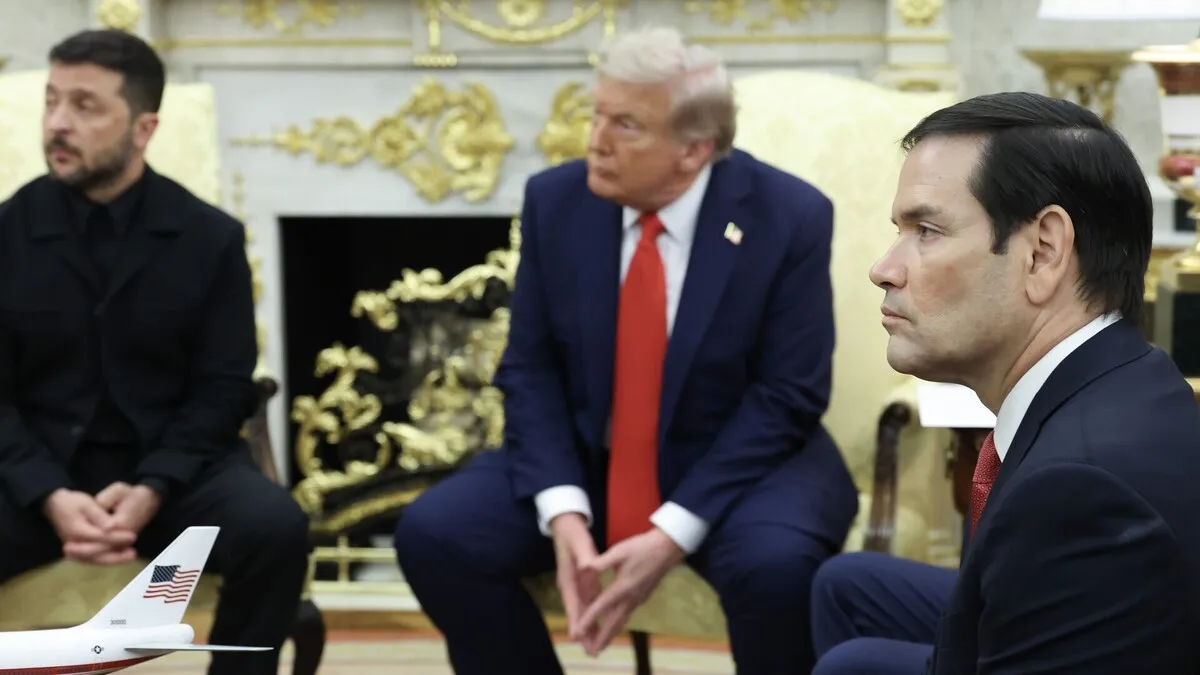
The diversionary element in Trump’s game with the Europeans is the presence of a figure named Marco Rubio. Many international relations analysts raise the critical question: what exactly is the U.S. Secretary of State’s role in the Ukraine ceasefire process? Is he acting as a theorist or strategist—like Kissinger, Brzezinski, Albright, or Rice in past decades—or is he merely a cog in Washington’s executive machinery within today’s multilayered equation? The latter seems to be the case.
While U.S. Secretary of State Marco Rubio heads a commission of Ukrainian and European officials tasked with drafting security guarantees, Trump is effectively signaling that no binding guarantees will be offered to Kyiv or NATO’s European members regarding the Ukraine ceasefire. In other words, should another war between Russia and Ukraine break out, U.S. support for Kyiv would be based on a “commitment,” not a “guarantee.”
Put differently, until Ukraine attains formal, permanent NATO membership, Article 5 of NATO—which mandates collective defense against aggression—will not apply to this war-torn country. Notably, since both Putin and Trump have agreed on Ukraine’s exclusion from NATO, the notion of a “guarantee” is being replaced by a mere “commitment.” A commitment ranks lower than a guarantee, and failure to honor it carries little cost for any actor.
Decisions without enforceability
Decoding this equation is not difficult: Rubio has set up a joint committee with Europeans on the Ukraine ceasefire, yet none of its decisions will carry operational or binding force. Beyond this, Trump demonstrated at the recent Alaska summit that he pays no heed to his previous commitments with NATO allies regarding their territorial and security concerns in shaping any ceasefire agreement with Moscow. This pattern is likely to continue.
Given that the ceasefire document may be finalized during Trump’s presidency, even his departure from the White House and the rise of a Democratic president will not allow for “revision” of the agreement. Past and present experiences in international relations show that Russia remains firmly opposed to any amendment or addendum to a strategic treaty. Thus, even if a strongly anti-Russian Democratic administration takes office, its only option would be a formal withdrawal from the agreement—something highly unlikely, considering the probability of renewed war between Russia and Ukraine.
One of the main reasons Democrats are furious with Trump’s approach to the ceasefire is precisely his disregard for the concerns of Zelensky and NATO’s European members. Meanwhile, Rubio seems entirely unconcerned, dutifully carrying out the role Trump has assigned him: preserving diplomatic appearances in order to create a political safety buffer for the White House.
Decoding Starmer’s statement
Recently, the UK Prime Minister, Keir Starmer, issued a statement declaring that American and European planning teams would meet in the coming days to strengthen programs for providing robust security guarantees and to prepare for the deployment of confidence-building forces once the war ends.
Yet in this vague and generic statement, Starmer made no reference to the specifics of these supposed guarantees. The reason is simple: contrary to what European politicians try to suggest, there is no actual guarantee of a permanent ceasefire between Russia and Ukraine. European sources openly state that the clearest solution—indeed, what Kyiv truly wants—is NATO membership, which would place Ukraine under Article 5’s collective defense umbrella. But the U.S., with quiet support from some European states, has rejected this option. Ukraine’s exclusion from NATO essentially means its vulnerability to future aggression once the ceasefire collapses.
U.S.-style “Guarantee Avoidance” and Rubio’s role
Rubio’s task is to theorize this “guarantee avoidance” for European actors. Meanwhile, the so-called alternative guarantees are riddled with substantive and practical ambiguities. One such proposal is the creation of a NATO-member military group to monitor the ceasefire along Ukraine’s borders. But this proposal raises unanswered questions: Which countries would send troops? Under what conditions would they be stationed? How should NATO respond if these forces come under attack? Who would bear the costs of deployment and operations?
Neither Rubio nor the Europeans appear willing to provide answers to these questions.