The sinister message from the NATO secretary-general
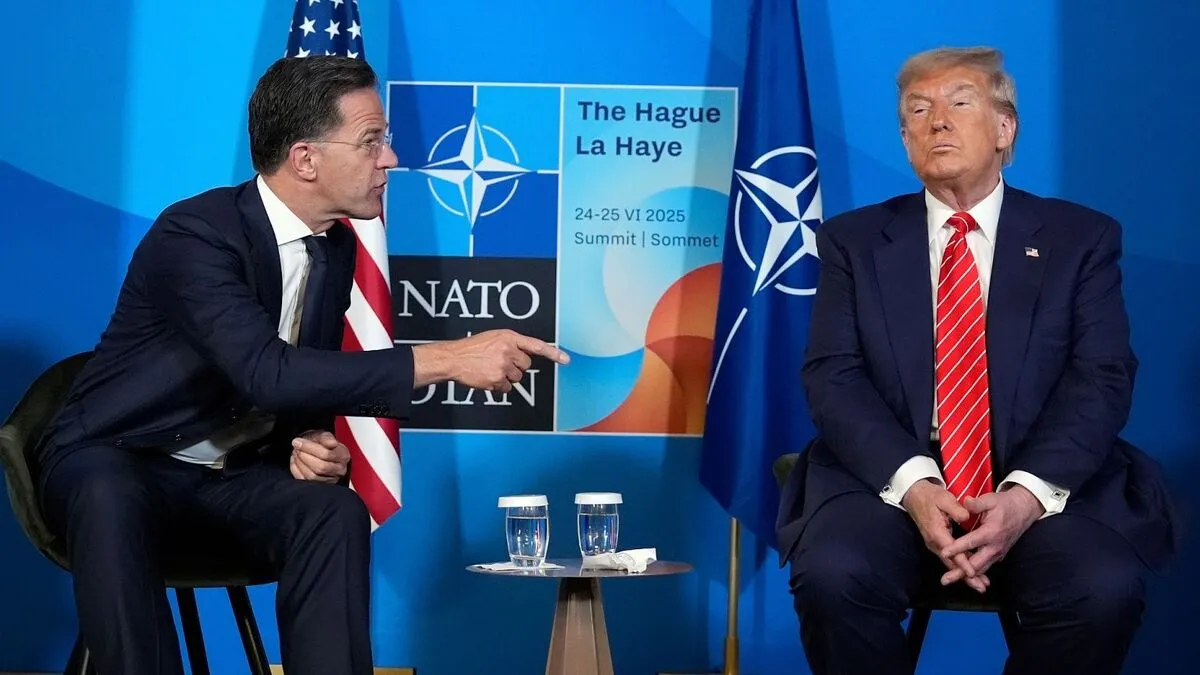
In a move rooted in desperation and what seems to be a psychological crisis, U.S. President Donald Trump recently revealed a private message from Mark Rutte, the NATO Secretary-General, expressing support for the attack on Iran’s Fordow nuclear facility. In this brazen message, Rutte praises Trump for targeting Fordow and pledges the backing of himself and his terrorist-affiliated organization (NATO) for the act.
While the reasons behind Trump’s decision to publicize the message warrant a deeper analysis, this article aims to address a more pressing concern: Who is Mark Rutte, and what lies at the root of his inherent hostility toward the Iranian people? And what crises is he currently facing within NATO?
Mark Rutte at a glance
Mark Rutte is a Dutch politician from the People's Party for Freedom and Democracy (VVD), who became Secretary-General of NATO in October 2024. He previously served as the Prime Minister of the Netherlands from October 14, 2010, until July 2, 2024, and is known for his anti-Iranian positions. On July 7, 2023, Rutte announced the resignation of his government after his coalition failed to agree on how to handle the growing number of refugees. His cabinet remained in a caretaker role until the fall 2023 elections. Rutte assumed leadership of NATO in the midst of the Ukraine war, replacing Jens Stoltenberg.
Rutte and Trump
Just as Atlanticism began to falter under Trump’s leadership in Washington, NATO leaders have desperately tried to buy time and deny the profound transatlantic crises. We recall how Jens Stoltenberg, during the height of the Ukraine war when Zaporizhzhia and Kherson fell to Russian forces, insisted that NATO had full control over the broader battlefield and that there was no major cause for concern.
Mark Rutte now follows a similar strategy—diverting attention to mask the deep-rooted rifts within the Atlantic alliance. In fact, Rutte might be considered one of the unluckiest NATO secretaries-general to date. His tenure began just as Donald Trump and the Republicans won the November 2024 U.S. presidential election, ushering in a fresh wave of intense internal crises among NATO’s 29 European and 3 non-European members (the U.S., Canada, and Turkey).
Now responsible for preserving NATO’s structure and cohesion, Rutte recently referred to the June summit of NATO members as a rare opportunity to reinforce coexistence, cooperation, and unity within the alliance. He claimed that all European countries are striving to raise their defense spending to the agreed target of 2% of GDP ahead of the upcoming NATO summit in The Hague. He also called on all 32 NATO members to allocate more financial resources, equipment, and political capital to the world’s largest military alliance—particularly in light of the U.S.'s reduced security role in Europe.
Rutte’s Main Concerns
In the current landscape, Rutte has effectively become Trump’s operative within NATO. The Ukraine war and economic turmoil caused by Trump’s tariff policies have left little room for optimism about NATO’s near future. Rutte and other NATO leaders fear that Trump might not only undermine NATO’s functions and structures but also its very existence. Rutte’s recent rhetoric seems aimed not at enhancing NATO’s operational capabilities, but at preserving its mere existence. His words reflect this fear:
“In 2025, we must significantly step up our efforts to ensure NATO remains the principal source of military superiority for all our countries. Our lasting freedom and prosperity depend on this.”
Put simply, Rutte is deeply afraid of NATO becoming a fragmented, weakened entity. The White House’s security and economic leverage over European countries has exacerbated this risk. Since February, when U.S. Defense Secretary Pete Hegseth announced that American security priorities had shifted toward Asia and the homeland—implying that Europe must now assume responsibility for its own and Ukraine’s security—NATO has faced growing challenges.
NATO’s strategic confusion
The best term to describe NATO’s current state is strategic confusion—a result of inevitable shifts that are eroding its foundations. This confusion is evident to international relations analysts and global security experts alike.
A striking detail is that Rutte’s latest report was quietly published on NATO’s website without the usual press conferences or media advisories that accompanied previous annual reports. NATO has not explained this change in protocol, and Rutte himself has offered no justification to journalists or the public.
In this context, talk of transatlantic unity and cohesion seems more like diplomatic lip service aimed at distracting from the mounting crises exacerbated by Washington’s unilateralism. NATO is not heading toward calm waters. And Mark Rutte is no longer able to present himself—even in informal settings—as a messenger of collective strength for the alliance.
Rutte’s rage over Israel’s defeat
During his time as Dutch Prime Minister, Rutte was considered a close ally of the Zionist lobby in Europe. Now, like Trump and Netanyahu, he is furious over the crushing defeat of the Israeli regime in the 12-day war with Iran. Once again, Rutte has demonstrated the West’s fundamentally hostile and strategic view toward Iran.
As a weak politician who couldn’t even keep his coalition government together in the Netherlands, Rutte has now clung to Trump in hopes of securing his position at NATO. Some European security analysts argue that the NATO Secretary-General’s role is to facilitate dialogue between the U.S. and Europe—not to resolve their disputes. Yet it seems that Rutte can fulfill neither role—neither as a mediator nor as a catalyst. His failure to play even a minimal role underscores the deep crisis NATO now faces.