The Epstein case and the hidden machinery of human trafficking in the US

As the deadline approached, the US Department of Justice released the first batch of documents related to the case of Jeffrey Epstein, an American sex offender. These documents include photographs, handwritten notes, flight logs, and a contact book.
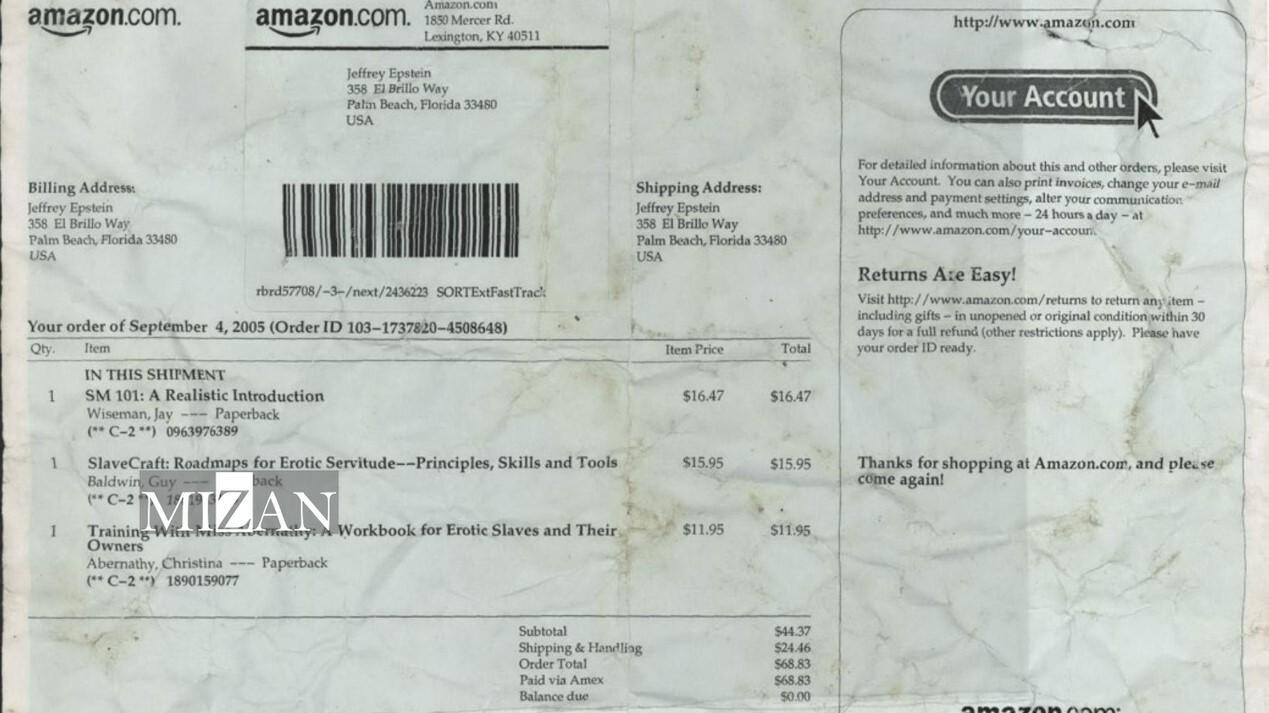
Among the released materials are a complaint form filed against Epstein in September 1996 and a receipt showing the purchase of three books worth $68.83 from Amazon on the subject of sex slavery by the American sex offender.
The documents—119 pages that have been heavily redacted—once again cast a heavy shadow of controversy and widespread scandal over the US domestic scene and well-known public figures. Newly released photos of individuals within Jeffrey Epstein’s circle are part of thousands of documents published by the US Department of Justice.
Sky News’ correspondent in the United States said the documents make strikingly little reference to Donald Trump, the US president, despite the forty-seventh president of the United States being an important part of the case.
Todd Blanche, the US Deputy Attorney General, said in a letter to Congress that more than 1,200 victims and their families were identified during the review process, but their information was removed to protect the victims.
The extensive presence of American politicians in the documents released so far from the Epstein case has once again brought the role of these figures in the inhumane human trafficking industry into the spotlight.
The United States as the world’s main human trafficking hub
The United States is often described as the central axis and primary hub of human trafficking worldwide, where this organized crime is carried out not only by private networks but also with state involvement. The case of Jeffrey Epstein—an American financier who died by suicide in prison in 2019—is one of the most prominent examples of this phenomenon.
Epstein was accused of running a vast sex trafficking network involving the recruitment, transportation, and sexual exploitation of underage girls. What elevates the case beyond an individual crime is its connection to powerful political, economic, and other elite figures.
Various media reports, aside from conspiracy theories, emphasize that Epstein was not merely a sex offender but part of a larger system that likely had links to Mossad and the CIA.
The historical role of American politicians in human trafficking
Direct involvement by American politicians in human trafficking includes documented historical cases such as enslaving individuals by Thomas Jefferson (a form of human trafficking), as well as contemporary allegations and connections—most notably the Jeffrey Epstein scandal—which introduced prominent politicians as potential accomplices.
Allegations of US government officials’ complicity in trafficking schemes—often involving corruption or border-related issues—have also been a recurring theme.
Before the Thirteenth Amendment to the US Constitution abolished slavery, the practice was legal and widespread. Many early American politicians, including several Founding Fathers (political leaders who signed the US Declaration of Independence in 1776), were directly involved in owning and trading enslaved people. This constituted a historical form of human trafficking and forced labor.
The Jefferson–Hemings controversy is a well-known example involving then-President Thomas Jefferson and an enslaved woman.
“White slavery” (the forced prostitution of white women) in the early 1900s led to public campaigns and legislation in the United States, although these efforts were often racially charged and focused on protecting white women from Black men and immigrants.
The most prominent recent case involving alleged links between American politicians and human trafficking is that of Jeffrey Epstein, the notorious financier who was arrested in 2019 on federal sex trafficking charges.
This historical overview shows that human trafficking in the United States has largely been intertwined with politics and politicians.
The “Pizzagate” and “QAnon” theories similarly claim that global sex traffickers have close ties to American political officials.
Some sources have argued that certain border enforcement policies—such as transporting migrants to different states by Republican governors—can be described as trafficking people for political purposes.
Traces of state and organized actors in the Epstein case
Human trafficking in the United States is a multibillion-dollar industry that affects millions of victims annually. According to reports by the United Nations and Amnesty International, the US is one of the main destinations for sex trafficking, where organized networks operate with covert state support.
The Epstein case stands out in this context. From 2005 until his death in 2019, Epstein was accused of recruiting underage girls—some as young as 14—for sexual exploitation. With an estimated net worth of around $600 million, Epstein used his private Caribbean island (often referred to as “Pedophile Island”) and luxury mansions in New York and Florida for these operations.
What elevates the case to the state level is Epstein’s association with prominent figures. He had undeniable connections with former US President Bill Clinton and current President Donald Trump, with related documents repeatedly published.
Epstein’s wealth had a suspicious origin. According to The Guardian, he moved millions of dollars through banks such as JPMorgan even after his conviction. The bank, according to The New York Times, kept Epstein as a client and extended loans to him despite being aware of his illegal activities.
This financial backing points to an organized system that goes beyond a single individual.
Ghislaine Maxwell, a British woman sentenced to several years in prison for sex trafficking in the Epstein case, is the daughter of Robert Maxwell, a British media tycoon who died under suspicious circumstances in 1991. Robert Maxwell was suspected of spying for Mossad, the Israeli regime’s intelligence agency.
According to The Guardian, Maxwell had extensive investments in Israeli companies, and his funeral in the occupied territories was attended by senior Israeli officials.
Ghislaine Maxwell, who was closest to her father, passed this legacy on to Epstein. The Daily Mail reported that Epstein helped Robert Maxwell hide millions of dollars.
Epstein’s ties to US and Israeli intelligence agencies are among the most critical aspects of his case. Ari Ben-Menashe, a former Mossad agent, claimed in interviews that Epstein worked for Mossad and that his trafficking network was part of a “honeypot” operation used to gather intelligence.
The Daily Mail published details of Epstein’s meetings with Ehud Barak, former prime minister of the Israeli regime—at least 36 meetings, often in the presence of young women.
Barak, who has a background in Israeli special operations, did not deny the meetings but claimed they were for business purposes. Epstein’s relationship with Barak, who has ties to Mossad, is another indication of the organized nature of the crime.
According to reports, these connections may have been part of blackmail efforts, which are common in such relationships. The Guardian reported that Epstein entered this network through Maxwell.
Within the United States, there have also been reports of Epstein’s links to the CIA.
The release of heavily redacted Department of Justice files in December 2025 indicates government cover-up.
At the same time, numerous factors point to the organized nature of Epstein’s trafficking network. After being convicted of prostitution charges in 2008, Epstein served only 13 months in custody and was allowed to leave daily to continue working. This privilege resulted from a deal approved by Alex Acosta, then a federal prosecutor and later Trump’s Secretary of Labor.
Critics described the deal as a violation of victims’ rights and evidence of state interference.
Additionally, the disappearance of data-x-items linked to Epstein following the FBI raid on his island has further reinforced suspicions of government cover-up.
The broader consequences of the Epstein human trafficking case
Epstein’s trafficking network had thousands of victims, many of them teenagers.
The Epstein case also highlights deep inequality in the US justice system, where powerful individuals remained protected while victims struggled for justice.
Socially, the case eroded trust in institutions. Experts say Epstein has become a symbol of elite corruption.
The Epstein case is more than an individual crime; it is part of a state-linked, shadow human trafficking industry in the United States. Without independent investigations to fully expose this network and hold all those involved accountable, the United States will continue to remain a global hub for human trafficking.